


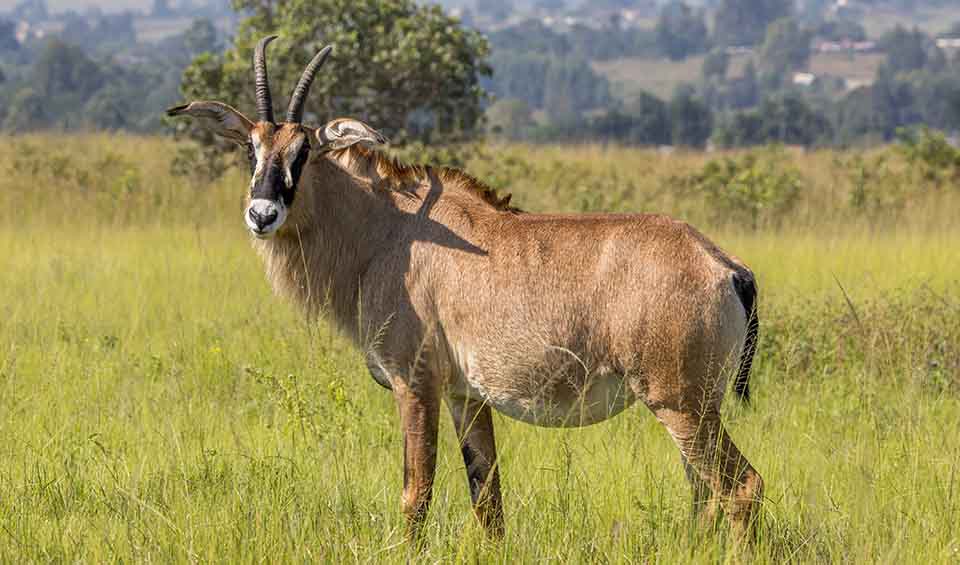
The name “roan” comes from the reddish-brown, almost chestnut coat color that’s similar to that of roan-colored horses. These impressive animals are found across savannas, woodlands, and grasslands in central and western Africa, and are among the largest antelope species on the continent.
Roan antelopes, both males and females, sport backward-curving, ringed horns, though the males’ are usually longer and thicker. Their faces are boldly marked with black and white patterns, almost like a natural mask, with dark patches around the eyes and snout and pale lines on the cheeks and forehead. This, combined with their short manes, large ears with black tips, and sturdy necks, gives them a noble, almost knightly appearance.
These antelopes live in small herds, typically made up of females and their young, led by a dominant female, while males are either solitary or form bachelor groups. Roan antelopes are grazers, feeding mainly on tall grasses, and they prefer open woodlands where they can find both cover and grazing space. They’re also known to be water-dependent, often found within reach of a water source.
Roan antelopes are extremely tough and defensive. When threatened by predators like lions or hyenas, they don’t always flee — they may stand their ground and fight back using their powerful horns, often targeting an attacker’s belly. Their courage, combined with size and strength, makes them a formidable opponent in the wild.
Distribution
 Angola
 Benin
Benin Botswana
 Burkina Faso
 Burundi
 Official estimate
 Cameroon
 Central Af. Rep.
 Chad
Chad Côte D’ivoire
 DR Congo (Kinshasa)
 Eritrea
Official estimate
Eritrea
Official estimate
 Eswatini
 Ethiopia
 Gambia
 Ghana
Ghana Guinea-Bissau
 Guinea
 Kenya
Kenya Malawi
 Mali
Mali Mozambique
 Namibia
 Niger
Niger Nigeria
 Rwanda
 Senegal
 South Africa
 South Sudan
 Sudan
Sudan Tanzania
 Togo
Togo Uganda
 Zambia
 Zimbabwe
Anything we've missed?
Help us improve this page by suggesting edits. Glory never dies!
Suggest an editGet to know me
Terrestrial / Aquatic
Altricial / Precocial
Polygamous / Monogamous
Dimorphic (size) / Monomorphic
Active: Diurnal / Nocturnal
Social behavior: Solitary / Pack / Herd
Diet: Carnivore / Herbivore / Omnivore / Piscivorous / Insectivore
Migratory: Yes / No
Domesticated: Yes / No
Dangerous: Yes / No




