


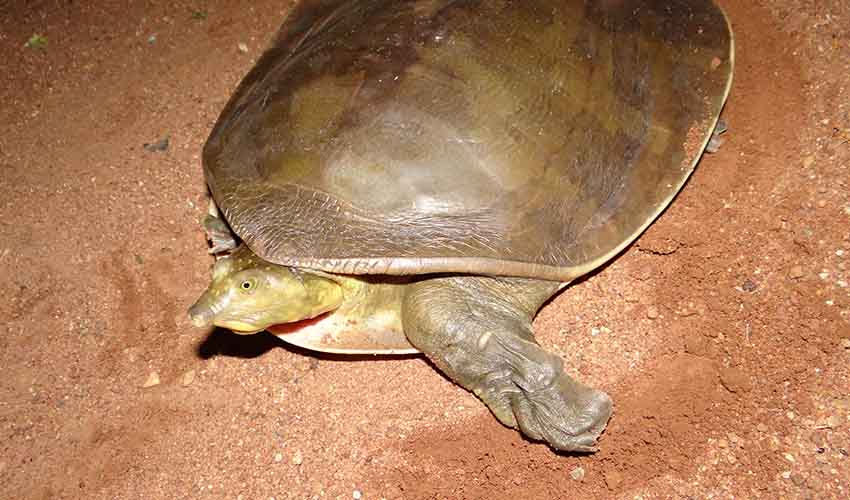
Instead of a tall, domed shell like many turtles, it has a flatter, smoother shell that helps it slip through water plants and shallow channels. Its most famous feature is hinted at in the name: along the underside, it has flexible “flaps” of shell and skin that can fold inward to cover softer parts of the body. Think of it as a turtle with a built-in jacket that can button up when it feels threatened. The head is usually broad, with a strong beak, and the feet are adapted for paddling, with sturdy claws that help it dig and scramble along muddy edges.
Compared with some larger African relatives that grow heavier and more robust, the Senegal flapshell is often the more streamlined, smaller-bodied option, built to handle a mix of habitats—quiet pools, slow rivers, flooded grasslands, and seasonal wetlands. Its shell is typically smoother and less “chunky” looking than some of its close cousins, and it tends to rely on speed and hiding as much as brute defense. Another difference is how comfortable it is in places that change a lot through the year. In regions where water appears and disappears with the rains, this turtle can shift from open water to shallow, plant-choked puddles without missing a beat.
The Senegal flapshell is not a show-off basker that spends hours sunning on logs; it’s more of a stay-low, keep-moving turtle. When startled, it often darts into the water and disappears into the bottom like it was never there. It’s also an enthusiastic eater and not particularly picky: insects, snails, small fish, tadpoles, and other bite-sized aquatic animals can all be on the menu, along with occasional plant matter. That “whatever’s available” diet is one reason it can do well in different wetlands. And those flaps aren’t just for drama—when the turtle tucks in, the flaps help shield the legs and softer underside, making it harder for a predator to grab anything important.
Distribution
 Benin
Benin Burkina Faso
 Cameroon
 Central Af. Rep.
 Chad
Chad Côte D’ivoire
 Ethiopia
 Gambia
 Ghana
Ghana Guinea-Bissau
 Guinea
 Liberia
 Mali
Mali Mauritania
 Niger
Niger Nigeria
 Senegal
 Sierra Leone
 South Sudan
 Sudan
Sudan Togo
TogoAnything we've missed?
Help us improve this page by suggesting edits. Glory never dies!
Suggest an editGet to know me
Terrestrial / Aquatic
Altricial / Precocial
Polygamous / Monogamous
Dimorphic (size) / Monomorphic
Active: Diurnal / Nocturnal
Social behavior: Solitary / Pack / Herd
Diet: Carnivore / Herbivore / Omnivore / Piscivorous / Insectivore
Migratory: Yes / No
Domesticated: Yes / No
Dangerous: Yes / No




