


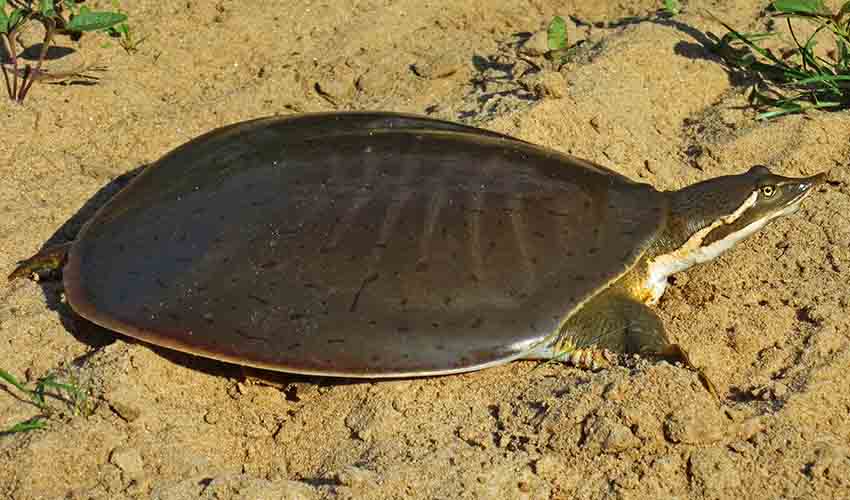
Instead of a hard, bumpy shell, it wears a flat, leathery “pancake” that feels more like thick rubber than armor. Its shell is usually olive, tan, or sandy, often sprinkled with small dark spots that help it blend into the river bottom. Add in a long, snorkel-like nose and wide, webbed feet, and you’ve got a turtle built less for sitting on a log and more for living like a stealthy swimmer. Smooth softshells spend most of their time in clean, flowing rivers with sandbars, where they can bury themselves quickly and watch the world with just their eyes and nose poking out.
What makes the smooth softshell especially distinct is right in its name: the front edge of its shell is smooth rather than spiky. That’s a big deal because one of its closest look-alikes, the spiny softshell, usually has small, sandpapery bumps near the front of the shell that feel like tiny studs. Smooth softshells also tend to have a cleaner, more even shell pattern and a sleeker overall shape—like the difference between a racing kayak and a rougher utility canoe. Their heads are often more streamlined, too, and their coloring frequently matches the pale sands of big rivers.
A smooth softshell can rocket away with a few strong kicks, then vanish by skimming along the bottom and burying itself in seconds. Even when resting, it has clever ways to stay hidden and comfortable: it can sit underwater for long periods, taking in oxygen through its skin and tissues while barely moving. When it’s time to eat, it shifts into hunter mode. Fish, crayfish, aquatic insects, and other small animals are on the menu, and it often grabs prey with a quick lunge rather than a slow chase. If startled on land, it looks awkward—but don’t be fooled. It can move surprisingly fast for a turtle, and it can give a sharp bite if handled, so it’s a better animal to admire than to pick up.
Distribution
 United States
United States
United StatesAnything we've missed?
Help us improve this page by suggesting edits. Glory never dies!
Suggest an editGet to know me
Terrestrial / Aquatic
Altricial / Precocial
Polygamous / Monogamous
Dimorphic (size) / Monomorphic
Active: Diurnal / Nocturnal
Social behavior: Solitary / Pack / Herd
Diet: Carnivore / Herbivore / Omnivore / Piscivorous / Insectivore
Migratory: Yes / No
Domesticated: Yes / No
Dangerous: Yes / No




