


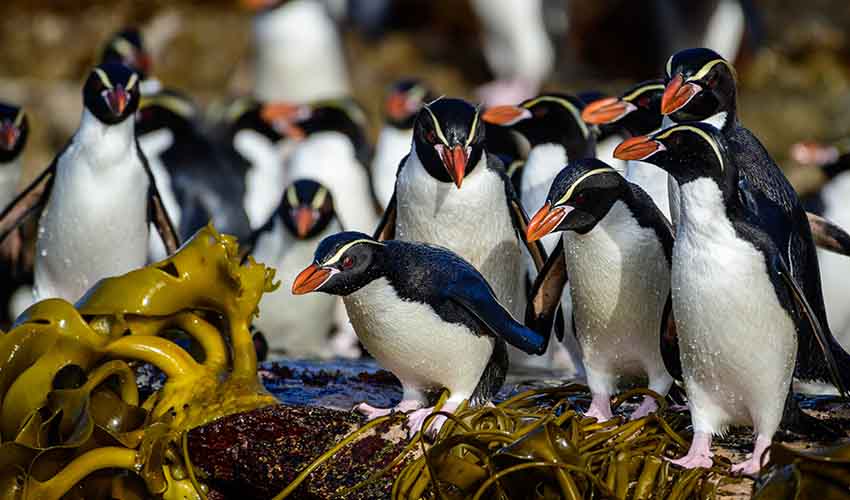
One of the most distinctive and least-known penguin species in the world, found only on the remote Snares Islands south of New Zealand. This limited range already sets it apart from most other penguins, which often live across wide coastlines or multiple regions. Medium-sized and sturdy, the Snares penguin has a bold appearance, with a deep black back, a clean white belly, and striking yellow eyebrow-like crests that stretch from above each eye and meet across the forehead. Its face often carries a serious, almost stern expression, making it instantly recognizable among penguins.
What truly distinguishes the Snares penguin from other crested penguins is the degree of isolation and protection in its life. The Snares Islands are uninhabited and strictly controlled, so these penguins live without direct human disturbance. Unlike some penguin species that nest on open beaches, Snares penguins prefer shaded forest floors and rocky clearings beneath trees and shrubs. They form dense breeding colonies, yet their nesting sites remain hidden and sheltered. Compared to related species such as the Fiordland or rockhopper penguins, the Snares penguin has thicker, heavier crests and a more compact body, giving it a powerful, grounded look.
The Snares penguin is also known for its energetic behavior on land. Getting from the sea to its nesting site is no easy task, as the coastline is steep and rugged. These penguins often leap out of crashing waves onto rocks and then climb uphill using a combination of hopping, flipper support, and sheer persistence. This challenging journey has made them remarkably strong and agile. Once inland, they follow narrow paths worn into the ground by generations of penguins, creating natural “penguin highways” through the vegetation.
Distribution
 Argentina
 Australia
 Falkland Islands
 New Zealand
Anything we've missed?
Help us improve this page by suggesting edits. Glory never dies!
Suggest an editGet to know me
Terrestrial / Aquatic
Altricial / Precocial
Polygamous / Monogamous
Dimorphic (size) / Monomorphic
Active: Diurnal / Nocturnal
Social behavior: Solitary / Pack / Flock
Diet: Carnivore / Herbivore / Omnivore / Piscivorous / Insectivore
Migratory: Yes / No
Domesticated: Yes / No
Dangerous: Yes / No




