


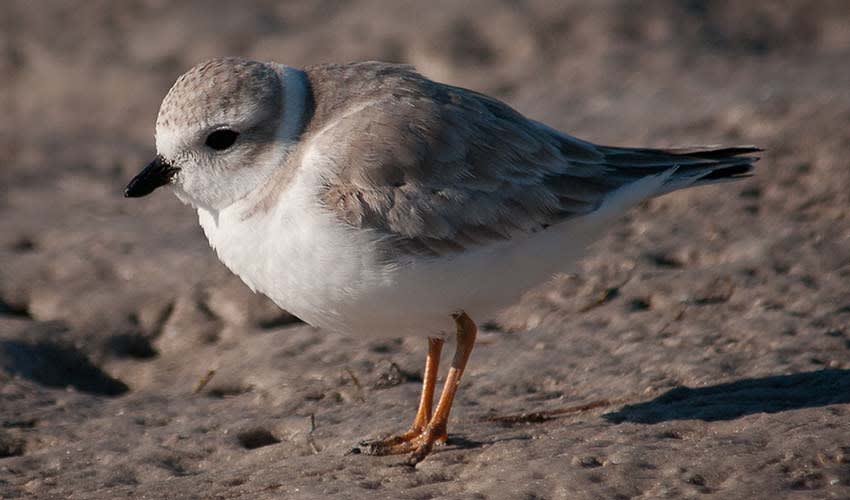
A tiny, pale shorebird that looks like it was designed to disappear into sun-bleached sand. Barely sparrow-sized, it has a round head, big dark eyes, a short, fine black bill, and long, slim grey-black legs. From above, it’s sandy brown, from below clean white, with small dark patches on the sides of the neck and behind the eyes that, in breeding males, sharpen into bolder black “ear” and forehead patches. Instead of a solid chest band like many other plovers, snowy plovers show a broken, incomplete band, giving them a delicate, lightly marked look.
This species is a beach and salt-flat specialist across the Americas. It breeds on open, sparsely vegetated shores where there’s more bare sand or salt crust than plants: ocean beaches, lagoon edges, salt and soda lakes, and wide sandy river bars. It also uses human-made habitats such as salt ponds, wastewater ponds, and dredge spoil islands. Coastal populations occur along the Pacific from Washington to Chile, along the Gulf of Mexico, and in the Caribbean and Bermuda, while inland breeders nest around saline lakes and flats in the western and central United States and parts of Mexico. On these open flats, snowy plovers feed in classic plover style: pause, scan, then dash and grab. Their diet is mostly tiny invertebrates—beetles, flies and their larvae, worms, small crustaceans and other arthropods—picked from the surface or probed from soft sand and mud.
Snowy plovers are also famous for flexible family life: in many populations, especially in North America, females frequently desert the first brood soon after hatching to find a new mate and lay a second clutch, leaving the original male to raise the first chicks alone.
Distribution
 Anguilla
 Aruba
Aruba Bahamas
 Bonaire Sint Eustatius And Saba
 British Virgin Is.
 Chile
Chile Colombia
 Cuba
Cuba Curaçao
 Dominica
 Dominican Republic
 Ecuador
 Haiti
Haiti Honduras
 Mexico
 Peru
Peru Puerto Rico
 Saint Barthélemy
 Saint Martin
 Sint Maarten
 St. Kitts & Nevis
 Turks & Caicos
 US Virgin Islands
 United States
 Venezuela
Anything we've missed?
Help us improve this page by suggesting edits. Glory never dies!
Suggest an editGet to know me
Terrestrial / Aquatic
Altricial / Precocial
Polygamous / Monogamous
Dimorphic (size) / Monomorphic
Active: Diurnal / Nocturnal
Social behavior: Solitary / Pack / Herd
Diet: Carnivore / Herbivore / Omnivore / Piscivorous / Insectivore
Migratory: Yes / No
Domesticated: Yes / No
Dangerous: Yes / No
Distribution
Anguilla
Aruba
Bahamas
Bonaire Sint Eustatius And Saba
British Virgin Is.
Chile
Colombia
Cuba
Curaçao
Dominica
Dominican Republic
Ecuador
Haiti
Honduras
Mexico
Peru
Puerto Rico
Saint Barthélemy
Saint Martin
Sint Maarten
St. Kitts & Nevis
Turks & Caicos
US Virgin Islands
United States
VenezuelaDid you know?
- fact 1
- fact 2
Anything we've missed?
Help us improve this page by suggesting edits. Glory never dies!
Suggest an editGet to know me
Terrestrial / Aquatic
Altricial / Precocial
Polygamous / Monogamous
Dimorphic / Monomorphic
Active: Diurnal / Nocturnal
Social behavior: Solitary / Pack / Herd
Diet: Carnivore / Herbivore / Omnivore / Piscivorous / Insectivore
Migratory: Yes / No
Domesticated: Yes / No
Dangerous: Yes / No




