


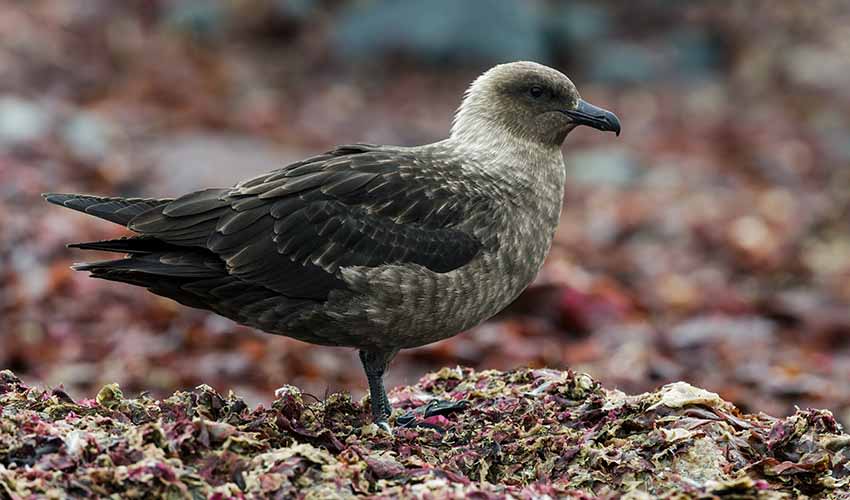
The South polar skua is like the bruiser of the Southern Ocean: stocky, powerful, and absolutely fearless. Adults are generally dark brown to smoky grey with bold white flashes at the base of the wings that really stand out when they fly. Some birds are paler, with a buff or straw-coloured head and neck, while others are almost uniformly dark. A heavy, hooked black bill, stout body, and direct, muscular flight make it look more like a flying predator than a dainty “seagull.”
This species breeds almost exclusively around the coasts of Antarctica, using ice-free ground close to the shore or near penguin and petrel colonies. Pairs form loose colonies or nest singly, scraping a shallow bowl in bare soil, moss, or gravel. They usually lay two olive-brown, blotched eggs in November–December, and both parents share incubation and chick-rearing. Skuas are famously aggressive around their nests: if you walk too close, adults will fly straight at your head in low, fast passes, screaming, until you back off.
Their diet and hunting style are a big part of their personality. South polar skuas are both hunters and pirates. They eat fish—often Antarctic silverfish and other small species—plus krill, penguin eggs and chicks, small seabirds, and carrion from seals and whales. Around penguin colonies, they can specialise as chick predators, memorising nest locations and patrolling like aerial wolves. They’re also classic kleptoparasites: they chase other seabirds such as petrels, terns, and even gannets until the victim drops or regurgitates its catch, which the skua then snatches in mid-air. Compared with the more agile, smaller skuas (jaegers), South polar skuas rely on brute force—barrel-chested, fast, and relentless.
Distribution
 Antarctica
 Antigua & Barbuda
 Argentina
 Australia
 Barbados
 Bermuda
 Bouvet Island
 Brazil
 British Virgin Is.
 Canada
 Chile
Chile Comoros
 Costa Rica
 Dominica
 Ecuador
 Egypt
Egypt Falkland Islands
 Fiji
Fiji French Guiana
 Greenland
 Guadeloupe
 Guatemala
 India
India Indonesia
 Israel
 Japan
Japan Jordan
 Kenya
Kenya Maldives
Martinique
Maldives
Martinique Mauritania
 Mauritius
 Mexico
 Micronesia
 Montserrat
 Morocco
 Mozambique
 Namibia
 New Zealand
 Oman
Oman Palau
Palau Panama
 Peru
Peru Portugal
 Saint Lucia
 Saint Pierre
 Saint Vincent
 Senegal
 Seychelles
 Somalia
 South Africa
 South Georgia
 Sri Lanka
 St. Kitts & Nevis
 Suriname
 Trinidad & Tobago
 US Virgin Islands
 United States
 Yemen
YemenAnything we've missed?
Help us improve this page by suggesting edits. Glory never dies!
Suggest an editGet to know me
Terrestrial / Aquatic
Altricial / Precocial
Polygamous / Monogamous
Dimorphic (size) / Monomorphic
Active: Diurnal / Nocturnal
Social behavior: Solitary / Pack / Flock
Diet: Carnivore / Herbivore / Omnivore / Piscivorous / Insectivore
Migratory: Yes / No
Domesticated: Yes / No
Dangerous: Yes / No




