


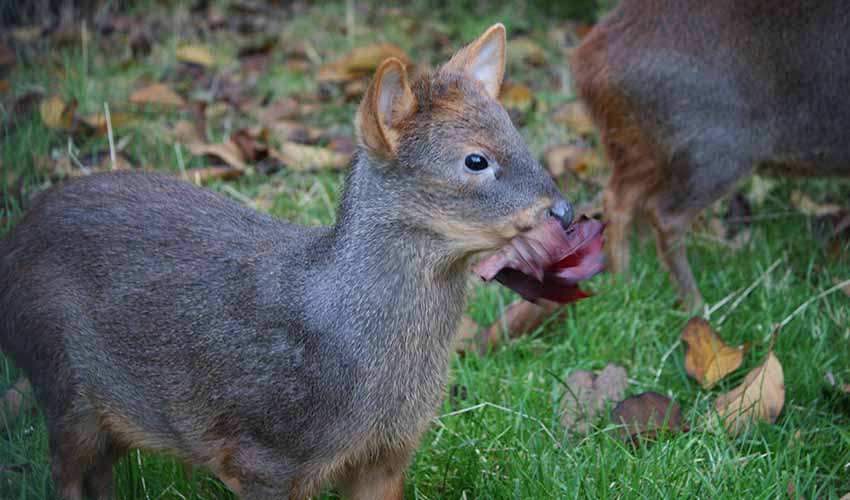
Native to the temperate rainforests of southern Chile and southwestern Argentina, this miniature ungulate is the smallest deer species in the world, and one of the most elusive. Found in dense, misty forests thick with ferns, bamboo, and moss, the southern pudu moves silently through the undergrowth, rarely seen by humans.
Physically, the southern pudu is strikingly small yet sturdily built. Its body is compact and rounded, with short legs, a short tail, and a dense coat of reddish-brown or dark chocolate fur that blends perfectly into the forest floor. The fur thickens during the cold Patagonian winters, offering insulation against chill and moisture. Males sport tiny, unbranched antlers that grow only 7 to 10 centimeters (3–4 inches) long, giving them a modest yet regal look. Their large dark eyes, short snouts, and round ears give them a perpetually gentle expression, while their narrow hooves allow them to navigate muddy slopes and tangled vegetation with ease. Despite their diminutive size, pudus are agile and strong, capable of leaping over fallen logs and climbing steep forest inclines.
Pudus are most active during dawn and dusk—times when the forest is quiet and the light dim enough to conceal them from predators like foxes, pumas, and domestic dogs. Their diet consists mainly of leaves, ferns, shrubs, bark, fallen fruit, and bamboo shoots. They are browsers, feeding on a wide variety of plants rather than grazing on grass. Incredibly, they have been observed standing on their hind legs or climbing low branches to reach higher leaves—an adorable and surprisingly athletic behavior for such a small animal. Their four-chambered stomachs allow them to digest fibrous vegetation efficiently, much like larger deer species.
Distribution
 Argentina
 Chile
ChileAnything we've missed?
Help us improve this page by suggesting edits. Glory never dies!
Suggest an editGet to know me
Terrestrial / Aquatic
Altricial / Precocial
Polygamous / Monogamous
Dimorphic (size) / Monomorphic
Active: Diurnal / Nocturnal
Social behavior: Solitary / Pack / Herd
Diet: Carnivore / Herbivore / Omnivore / Piscivorous / Insectivore
Migratory: Yes / No
Domesticated: Yes / No
Dangerous: Yes / No




