


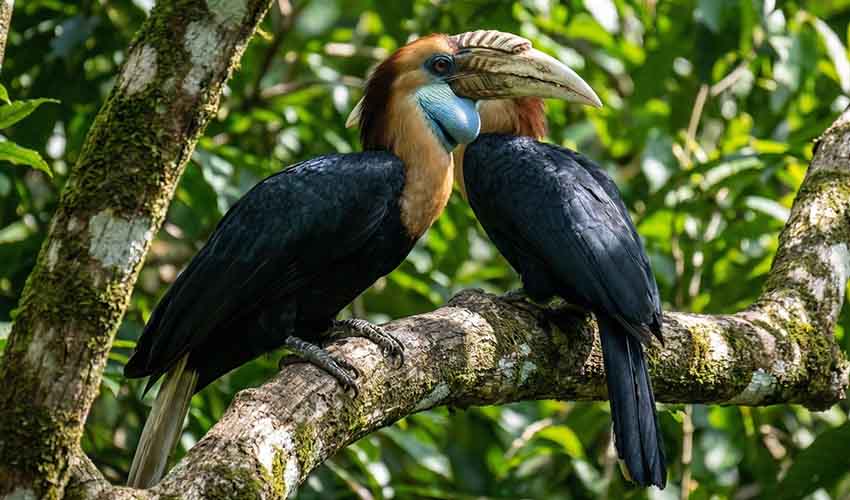
The Sumba hornbill is a medium-sized island hornbill that manages to look both elegant and slightly rugged at the same time. Endemic to the Indonesian island of Sumba and found nowhere else in the world. Its body is mostly dark, giving it a blackish overall look, but males have a rich reddish-brown crown and nape with a paler neck, while females are almost entirely black, so the two sexes look quite different at a glance. Both share the same impressive headgear: a long, dull yellow to creamy bill with a reddish or maroon patch at the base and a serrated casque along the upper ridge, plus an inflatable blue throat patch that can puff out when they call or display.
Life for the Sumba hornbill is all about fruit and big trees. These birds spend most of their time in the mid and upper canopy of forest, flying between fruiting trees and using their powerful bills to pluck and swallow figs and other fleshy fruits whole. Like other hornbills, they act as important seed dispersers: seeds swallowed with the pulp are later dropped far from the parent tree in nutrient-rich droppings, helping to regenerate the forest and maintain a mix of plant species. Insects and small animals make up only a minor side dish, though they become more important when parents are feeding chicks.
The species is socially monogamous, and pairs may stay together for many years, moving through the forest as a team and calling to each other with repeated clucking notes that can be heard hundreds of metres away. At good fruiting trees, several birds may gather, but overall they are far less flocking than some smaller hornbills, giving the impression of scattered family units rather than big, noisy crowds.
Distribution
 Indonesia
 Official estimate
Anything we've missed?
Help us improve this page by suggesting edits. Glory never dies!
Suggest an editGet to know me
Terrestrial / Aquatic
Altricial / Precocial
Polygamous / Monogamous
Dimorphic (size) / Monomorphic
Active: Diurnal / Nocturnal
Social behavior: Solitary / Pack / Flock
Diet: Carnivore / Frugivore / Omnivore / Piscivorous / Insectivore
Migratory: Yes / No
Domesticated: Yes / No
Dangerous: Yes / No




