


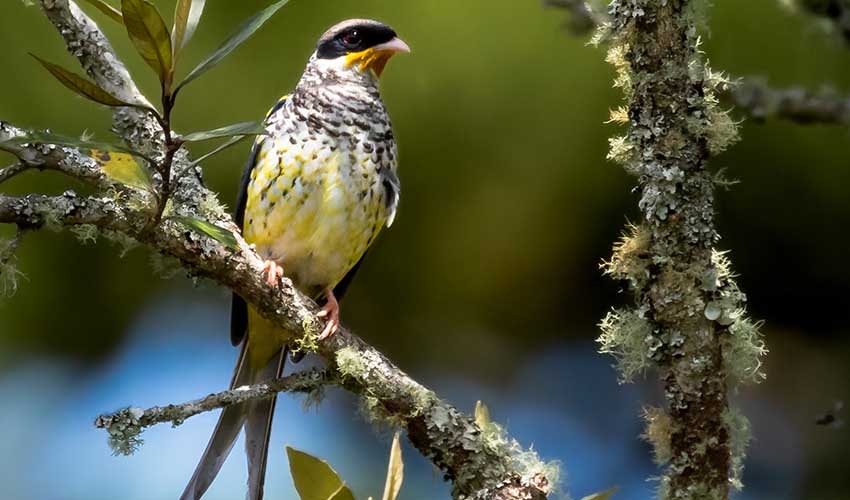
One of those birds that looks almost unreal, like a tropical ornament that somehow learned to fly. The male is the real showstopper: a bright, glossy blue body paired with a dramatic, deeply forked tail that trails behind him like a ribbon. That tail is the feature that gives the species its name, and it’s not a subtle detail—it’s long enough to change the whole silhouette of the bird in flight. Females look very different, wearing more muted brownish tones that help them blend into the treetops, which is useful in dense forests where staying unnoticed can matter. Even with all that color, this cotinga can be surprisingly hard to spot because it often stays high in the canopy, where leaves, light, and shadows break up its outline.
While plenty of cotingas are famous for bright colors, the swallow-tailed cotinga combines that bold blue with a shape that’s instantly recognizable at a distance. It also tends to look sleeker than some of its chunkier relatives, and in flight it can seem more buoyant, with the tail acting like a visual signature as it glides between treetops. Another distinguishing point is its overall vibe: many cotingas are colorful but oddly quiet and still, almost statue-like. This species can be that way too, but the long tail adds constant drama—every small turn, hop, or wingbeat makes it flutter and flick, like a flag catching a breeze.
The swallow-tailed cotinga is closely tied to Brazil’s Atlantic Forest region, where it favors forest edges, tall woodlands, and sometimes nearby clearings that still offer big trees for perching. It feeds mainly on fruit, which means it plays a useful role as a seed carrier—swallowing fruit and later helping plants spread to new spots. Watching one feed can be surprisingly calm: it may sit upright on a high branch, pick fruit with neat movements, and pause for long moments as if it’s listening to the forest.
Distribution
 Argentina
 Brazil
 Paraguay
Anything we've missed?
Help us improve this page by suggesting edits. Glory never dies!
Suggest an editGet to know me
Terrestrial / Aquatic
Altricial / Precocial
Polygamous / Monogamous
Dimorphic (size) / Monomorphic
Active: Diurnal / Nocturnal
Social behavior: Solitary / Pack / Herd
Diet: Carnivore / Frugivore / Omnivore / Piscivorous / Insectivore
Migratory: Yes / No
Domesticated: Yes / No
Dangerous: Yes / No




