


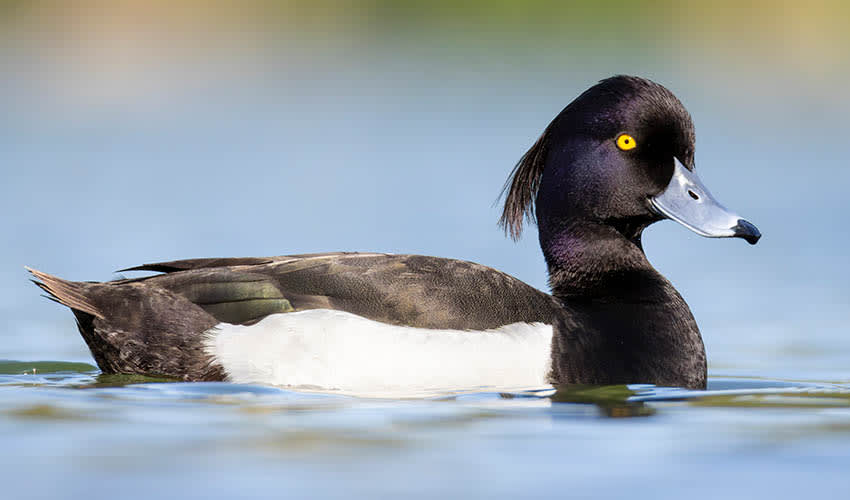
A sleek, charismatic diving duck found across Eurasia, instantly recognizable by the little plume of feathers that gives the species its name. Males are especially striking: glossy black plumage, a purple or green sheen on the head, bright yellow eyes, crisp white flanks, and, of course, the signature drooping head tuft. Females are subtler but still handsome, dressed in rich chocolate-brown with a smaller, less dramatic tuft. Both sexes have a smooth, bluish-gray bill tipped with black, giving them an elegant, almost sculpted appearance.
Tufted ducks are classic divers, built for underwater foraging with compact bodies and strong legs set far back on the torso. They feed by plunging beneath the surface to search for mollusks, insects, crustaceans, seeds, and aquatic plants, often staying submerged for 10–20 seconds at a time. Their preferred habitats include lakes, reservoirs, slow-moving rivers, and coastal bays, especially those with plenty of deep, open water. In winter, they gather in large, bustling flocks called rafts, sometimes numbering in the thousands — a spectacular sight when the whole group takes flight in a synchronized burst.
During the breeding season, tufted ducks shift to quieter wetlands with surrounding vegetation, where females build nests hidden among reeds or grasses. A typical clutch contains 8–11 eggs, and the female does all the incubation. Once hatched, the ducklings are lively, fast-moving swimmers, often forming small crèches with other broods. Males, after the mating season, leave to undergo molt migration, heading to safe, food-rich wetlands to replace their flight feathers.
Although widespread and currently considered Least Concern, the tufted duck faces challenges similar to many waterfowl: habitat degradation, pollution, wetland drainage, and the effects of warming climates that alter food availability and migration patterns. In several regions, populations have shown slight declines linked to water quality issues and invasive species that disrupt the food chain.
Distribution
 Afghanistan
 Albania
 Algeria
 Armenia
 Austria
 Azerbaijan
 Bahrain
 Bangladesh
 Belarus
 Belgium
 Bermuda
 Bhutan
 Bosnia And Herz.
 Brunei
 Bulgaria
 Cameroon
 Canada
 Cape Verde
 Chad
Chad China
China Croatia
 Cyprus
 Czechia
 Côte D’ivoire
 DR Congo (Kinshasa)
 Denmark
 Djibouti
 Egypt
Egypt Eritrea
 Estonia
 Ethiopia
 Faroe Islands
 Finland
 France
 Gambia
 Georgia
 Germany
 Gibraltar
 Greece
 Greenland
 Guam
Guam Hong Kong
 Hungary
 Iceland
 India
India Indonesia
 Iran
Iran Iraq
Iraq Ireland
 Israel
 Italy
Italy Japan
Japan Jordan
 Kazakhstan
 Kenya
Kenya Korea
Korea Kuwait
 Kyrgyzstan
 Laos
Laos Latvia
 Lebanon
 Libya
Libya Liechtenstein
 Lithuania
 Luxembourg
 Malawi
 Malaysia
 Maldives
 Mali
Mali Malta
Malta Marshall Islands
 Mauritania
 Micronesia
 Mongolia
 Montenegro
 Morocco
 Myanmar
 Nepal
Nepal Netherlands
 Niger
Niger Nigeria
 Nort. Mariana Is.
 North Korea
 North Macedonia
 Norway
 Oman
Oman Pakistan
 Palau
Palau Philippines
 Poland
 Portugal
 Qatar
Qatar Romania
 Russia
 Saudi Arabia
 Senegal
 Serbia
 Sierra Leone
 Singapore
 Slovakia
 Slovenia
 Somalia
 South Sudan
 Spain
Spain
Spain
Spain Sri Lanka
 Sudan
Svalbard
Sudan
Svalbard Sweden
 Switzerland
 Syria
Syria Taiwan
 Tajikistan
 Tanzania
 Thailand
 Tunisia
 Turkmenistan
 Turkey
 UAE
UAE Uganda
 Ukraine
 United Kingdom
 United States
 Uzbekistan
 Vietnam
 Yemen
YemenAnything we've missed?
Help us improve this page by suggesting edits. Glory never dies!
Suggest an editGet to know me
Terrestrial / Aquatic
Altricial / Precocial
Polygamous / Monogamous
Dimorphic (size) / Monomorphic
Active: Diurnal / Nocturnal
Social behavior: Solitary / Pack / Flock
Diet: Carnivore / Herbivore / Omnivore / Piscivorous / Insectivore
Migratory: Yes / No
Domesticated: Yes / No
Dangerous: Yes / No




