


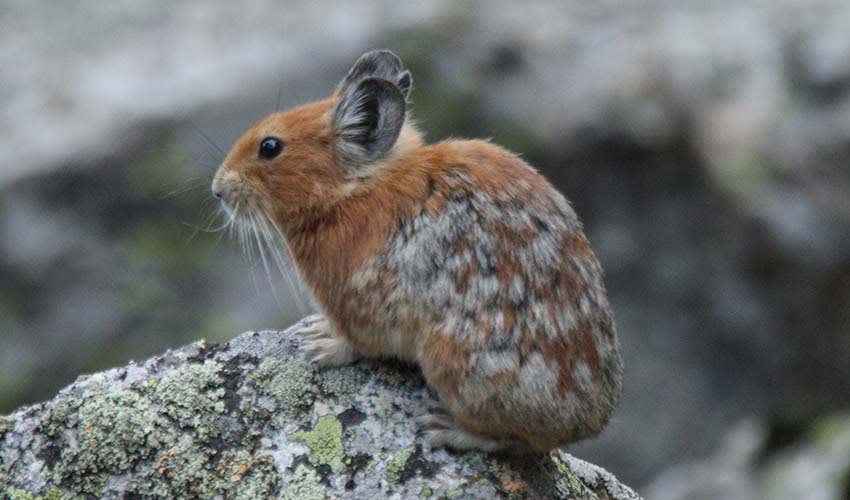
A small, tailless mountain mammal that looks like a rabbit that’s been rounded off and trimmed for life among rocks. It has a compact body, short legs, and small, rounded ears, which give it a “plush” silhouette compared with long-eared rabbits and hares. What makes it especially memorable is its color shift through the year: in summer, the fur along its back can turn a bright rusty red, while the belly stays pale; in winter, the back fades into softer browns and grays that match cold-season stone and dry plants.
Some pikas are famous for living extremely high above the trees or for digging big tunnel systems in open grasslands. The Turkestan red pika is more of a rock-slope specialist at moderate-to-high elevations, often living in piles of broken rock and boulder-strewn slopes where there are countless gaps to hide in. It doesn’t need to dig much when the landscape already offers ready-made escape routes. That habitat choice shapes its whole survival strategy: instead of racing across open ground, it relies on short, fast dashes from cover to cover, then vanishes into a crack so narrow you wonder how anything fits inside. Its range also helps set it apart. It lives in a patchwork of Central Asian mountain areas—places like the Tian Shan and Pamirs—and extends into western China, which means it’s adapted to a world of sharp seasonal change, intense sun, and sudden storms rather than the more uniform conditions some other pika species experience.
Its daily life is full of clever, practical habits. The Turkestan red pika is active above ground when conditions are favorable, but it’s always negotiating temperature and safety: too hot, too windy, or too risky, and it slips back into the rock maze. Winter brings an extra twist—snow can be both a challenge and a helper. Deep snow can make it harder to reach food, but snow can also act like an insulating blanket, keeping the space under it warmer than the open air. That means a pika’s “home” can be a little pocket of steadier temperatures while the world above is bitter and loud.
Distribution
 China
China Kazakhstan
 Kyrgyzstan
 Tajikistan
 Uzbekistan
Anything we've missed?
Help us improve this page by suggesting edits. Glory never dies!
Suggest an editGet to know me
Terrestrial / Aquatic
Altricial / Precocial
Polygamous / Monogamous
Dimorphic (size) / Monomorphic
Active: Diurnal / Nocturnal
Social behavior: Solitary / Pack / Herd
Diet: Carnivore / Herbivore / Omnivore / Piscivorous / Insectivore
Migratory: Yes / No
Domesticated: Yes / No
Dangerous: Yes / No




