


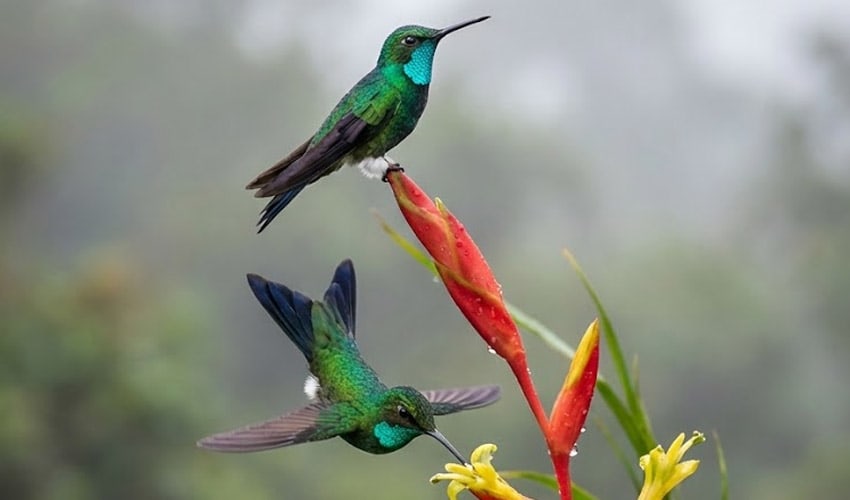
One of the most mysterious hummingbirds on Earth—so rare that it has almost become a legend. It belongs to a group of Andean hummingbirds nicknamed “pufflegs” because they wear dramatic, fluffy leg tufts that look like tiny white pom-pom pants. On the turquoise-throated puffleg, those leg “puffs” stand out sharply against a mostly green, glossy body. The male is said to be especially striking: when the light hits just right, its throat flashes a turquoise-to-violet shimmer, like a jewel that changes color as it moves. Even in a family of birds famous for sparkle, that bright throat patch and the bold white leg tufts make it sound unforgettable—if only people could reliably find one in the wild.
Many pufflegs have clear, well-mapped ranges and can be found with patience in the right mountain habitats. The turquoise-throated puffleg is different: it is known from only a handful of collected specimens from the 1800s, with one confirmed historical locality in northern Ecuador. Since then, it has largely slipped out of view. People have searched for it repeatedly, and there have been reports and rumors over the years, but nothing solid that settles the question of whether it still survives.
Its home, at least historically, was in Andean valleys and slopes, where habitats have changed dramatically over time. The Andes are a patchwork of steep ridges and microclimates, and hummingbirds often depend on very specific bands of elevation and certain flowers or forest edges. If those places are cleared or broken into small fragments, a specialized bird can vanish without many people noticing—especially a bird that is small, fast, and easy to miss. The turquoise-throated puffleg, if it still exists, would likely live a typical hummingbird schedule: feeding often to power its nonstop metabolism, hovering at blossoms for nectar, and snapping up tiny insects for protein.
Distribution
 Colombia
 Ecuador
Anything we've missed?
Help us improve this page by suggesting edits. Glory never dies!
Suggest an editGet to know me
Terrestrial / Aquatic
Altricial / Precocial
Polygamous / Monogamous
Dimorphic / Monomorphic (size)
Active: Diurnal / Nocturnal
Social behavior: Solitary / Pack / Herd
Diet: Carnivore / Nectarivore / Omnivore / Piscivorous / Insectivore
Migratory: Yes / No
Domesticated: Yes / No
Dangerous: Yes / No




