


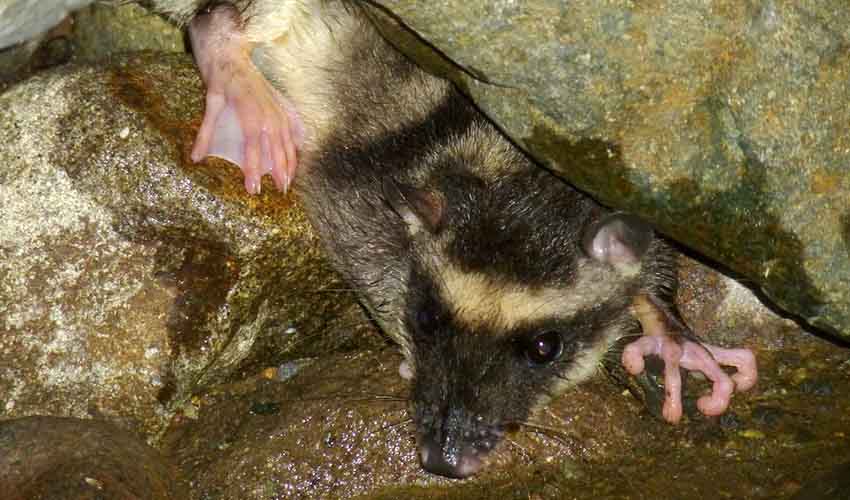
The only truly semi-aquatic marsupial in the Americas, and it looks like an opossum that decided to become a river otter’s quirky cousin. It has thick, dense fur that helps keep water off its skin, a long tail, and a sharp, alert face built for hunting in low light. Its coloring is especially striking: many have bold dark-and-light patches that can make them look “painted,” which is unusual for opossums. But the real giveaway is in the feet. The hind feet are webbed, turning them into natural paddles, and the animal swims with confident strokes, gliding through streams and rivers where most other opossums would never dare to hunt.
Most opossums are climbers, ground foragers, or opportunistic scavengers; the water opossum is a nighttime swimmer and underwater hunter. It often patrols along riverbanks and forest streams, slipping into the water with hardly a splash. One of its most clever features is the way it handles parenting. Female water opossums have a pouch that can close tightly, and it opens in a way that helps keep the babies protected while she swims, almost like a built-in dry bag. Even more unusual, males also have a pouch-like fold of skin that can cover and protect their private parts while swimming—something you don’t hear about every day in mammals.
At night, the water opossum turns rivers into hunting grounds. It eats a wide mix of prey, including aquatic insects, small fish, crustaceans, and frogs, depending on what’s available. It’s not a long-distance chaser; it’s more of a careful prowler, using quiet movement and quick grabs. You can imagine it creeping along a bank, pausing to listen, then diving in to investigate a ripple or a shadow. It has strong senses for finding food in murky water, and it can hold its breath long enough to make short underwater searches.
Distribution
 Argentina
 Belize
 Bolivia
 Brazil
 Colombia
 Costa Rica
 Ecuador
 El Salvador
 French Guiana
 Guatemala
 Guyana
 Honduras
 Mexico
 Nicaragua
 Panama
 Paraguay
 Peru
Peru Suriname
 Uruguay
 Venezuela
Anything we've missed?
Help us improve this page by suggesting edits. Glory never dies!
Suggest an editGet to know me
Terrestrial / Aquatic
Altricial / Precocial
Polygamous / Monogamous
Dimorphic (size) / Monomorphic
Active: Diurnal / Nocturnal
Social behavior: Solitary / Pack / Herd
Diet: Carnivore / Herbivore / Omnivore / Piscivorous / Insectivore
Migratory: Yes / No
Domesticated: Yes / No
Dangerous: Yes / No




