


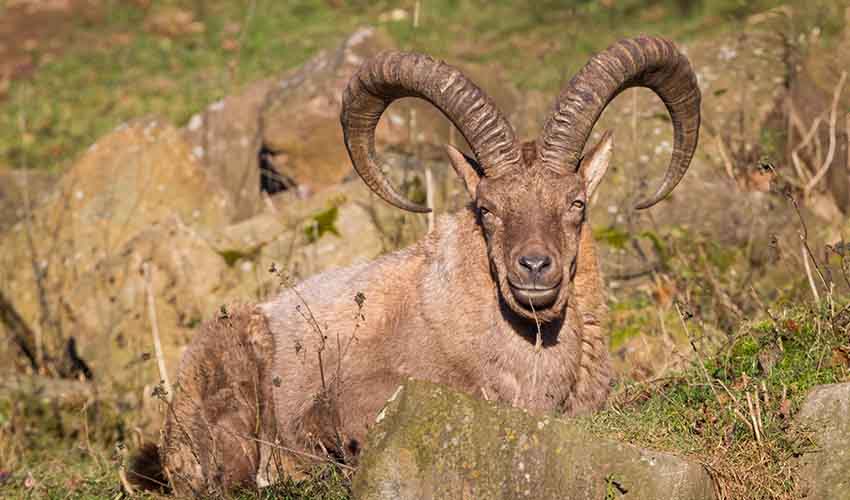
A rugged, sure-footed mountain goat-antelope found only in the western Caucasus Mountains of Russia and Georgia. Living high among steep cliffs, rocky slopes, and alpine meadows, this species is built for vertical life — think of it as the mountaineering specialist of the ungulate world. Stocky and muscular with coarse brown fur that thickens in winter, the West Caucasian tur blends effortlessly into its craggy surroundings. Males are especially striking: they sport massive, backward-curving horns with deep ridges, sometimes over a meter long, while females have slimmer, shorter horns.
Life at altitude demands agility, and the tur delivers. Its hard hooves with rubber-like pads give it remarkable grip, allowing it to scramble across near-vertical rock faces with calm confidence. Turs move in rugged terrain where few predators or humans can follow, climbing to higher elevations in summer to feed on alpine grasses and herbs, then descending to slightly lower slopes in winter. They often form small herds, with females and young gathering together, while males can be more solitary or join loose bachelor groups outside the breeding season.
The rut, or mating season, takes place in autumn and early winter, when males compete for dominance through displays, clashes, and horn-locking battles. Females usually give birth in secluded rocky ledges in spring, where kids quickly learn to balance and leap — survival in these steep environments demands fast learning and nimble feet. Despite their rugged nature, West Caucasian turs are cautious and alert, often difficult to spot as they rest on sunlit cliffs with panoramic views of potential threats.
Unfortunately, the West Caucasian tur is considered Endangered. Its limited range, combined with poaching, habitat pressure, and competition with domestic livestock, has led to significant declines. Historically, trophy hunting also impacted the species, and while protected areas and restrictions exist today, illegal hunting remains a concern.
Distribution
 Georgia
 Russia
Anything we've missed?
Help us improve this page by suggesting edits. Glory never dies!
Suggest an editGet to know me
Terrestrial / Aquatic
Altricial / Precocial
Polygamous / Monogamous
Dimorphic (size) / Monomorphic
Active: Diurnal / Nocturnal
Social behavior: Solitary / Pack / Herd
Diet: Carnivore / Herbivore / Omnivore / Piscivorous / Insectivore
Migratory: Yes / No
Domesticated: Yes / No
Dangerous: Yes / No




