


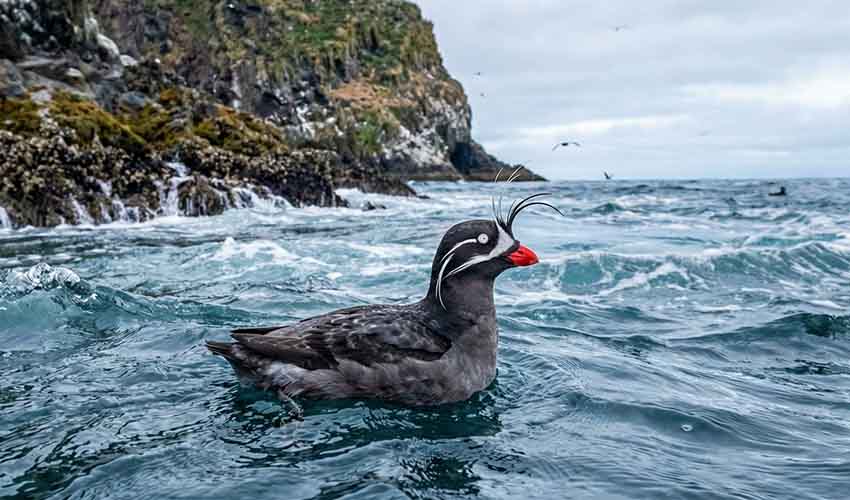
One of the quirkiest seabirds in the North Pacific—picture a slate-grey puffin with fancy white face whiskers. It’s only a little bigger than a starling, with a compact body, short wings, and a stubby bill for an auk. When breeding, it looks mostly dark grey-black with a small white patch on the shoulder and bright orange legsIts most striking features are the long, stiff white plumes above and below the eyes and a dark crest that curls over the forehead. These “whiskers” are not just for show.
Experiments have found that the birds bump into tunnel walls much more often when the plumes are taped down, which suggests they use them to feel their way through rocky crevices at night, much like a cat uses its whiskers. Their feathers also have a faint citrus scent, and people who work with them say they smell like tangerines.
Unlike many seabirds that travel long distances, whiskered auklets stay near their breeding islands all year. They even roost on land in winter, which is rare for alcids, since most sleep at sea outside the breeding season. At sea, they prefer inshore waters, where strong tidal currents create fronts and whirlpools that gather their plankton food. In summer, they mostly eat large copepods like Neocalanus plumchrus. In autumn and winter, they switch to eating swarms of krill and other small crustaceans.
Whiskered auklets nest in crevices, slipping into gaps in talus slopes, boulder piles, and cliff cracks to raise a single chick. They breed in loose colonies, often with other auklets, but in much lower numbers than the tightly packed least and crested auklets. Their nest is usually just bare rock or soil deep inside a crack, where they lay the egg.
Distribution
 Japan
Japan Russia
 United States
Anything we've missed?
Help us improve this page by suggesting edits. Glory never dies!
Suggest an editGet to know me
Terrestrial / Aquatic
Altricial / Precocial
Polygamous / Monogamous
Dimorphic (size) / Monomorphic
Active: Diurnal / Nocturnal
Social behavior: Solitary / Pack / Colony
Diet: Carnivore / Herbivore / Omnivore / Piscivorous / Insectivore
Migratory: Yes / No
Domesticated: Yes / No
Dangerous: Yes / No




