


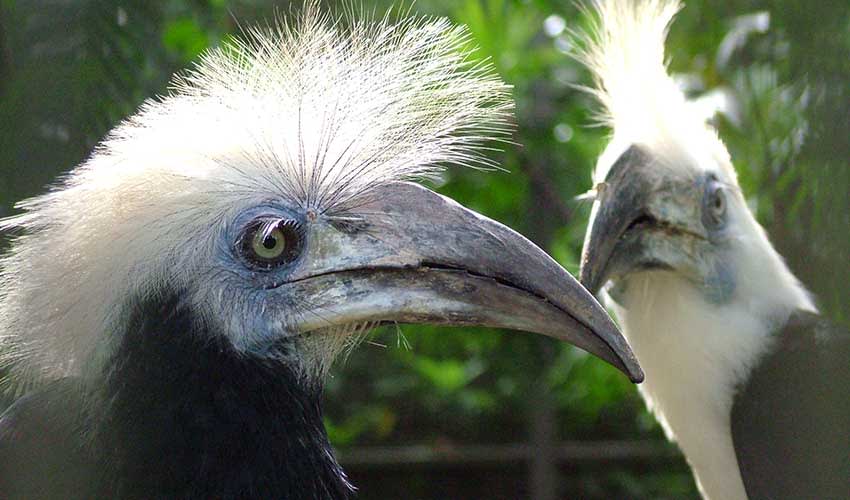
Best known for its wild-looking head of feathers: a shaggy, bright white crown that can resemble a swept-back wig or a splash of foam. Against this striking “hairdo,” the rest of the bird looks sleek and dark, giving it a bold black-and-white contrast that is hard to forget once you’ve seen it. It is a large hornbill with a long, curved bill and a casque (the helmet-like ridge on top), which adds to its prehistoric silhouette as it moves through the canopy. It lives in the lowland and hill forests of the Malay Peninsula, Sumatra, and Borneo, where tall trees, thick vines, and fruiting figs create a rich, layered world.
This hornbill is mostly a canopy traveler, spending much of its time high in the trees. Its favorite foods are fruits—especially figs—though it may also take insects and other small forest snacks when available. Because it swallows fruit and later drops the seeds far from the parent tree, it works like a flying gardener, helping the forest renew itself. If you think of a rainforest as a living city of trees, the White-crowned Hornbill is one of the key delivery workers moving “plant packages” from place to place. You often notice hornbills by sound: their wingbeats can be heavy and whooshing, and their calls can carry through the forest, making them feel larger-than-life even when they’re hidden by leaves.
What distinguishes Berenicornis comatus from other hornbills is its unmistakable white crown and the overall “high-contrast” look, which is rarer among hornbills that are often mostly brown, black, or chestnut. The crown isn’t just a pretty feature—it also helps individuals stand out to each other in the dark green canopy, where visibility is limited and quick recognition matters. Another standout trait is how strongly this bird depends on intact forest with large fruiting trees.
Distribution
 Brunei
 Indonesia
 Malaysia
 Myanmar
 Thailand
Anything we've missed?
Help us improve this page by suggesting edits. Glory never dies!
Suggest an editGet to know me
Terrestrial / Aquatic
Altricial / Precocial
Polygamous / Monogamous
Dimorphic (size) / Monomorphic
Active: Diurnal / Nocturnal
Social behavior: Solitary / Pack / Herd
Diet: Carnivore / Herbivore / Omnivore / Piscivorous / Insectivore
Migratory: Yes / No
Domesticated: Yes / No
Dangerous: Yes / No




