


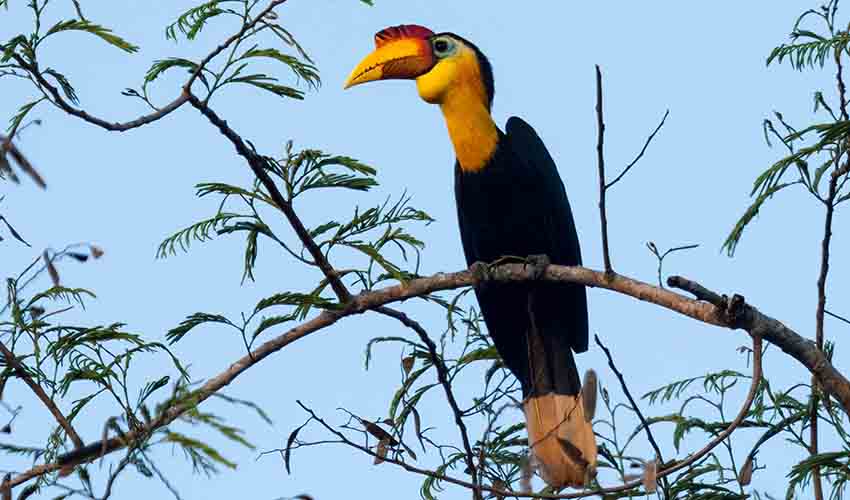
One of Southeast Asia’s most eye-catching forest birds, famous for its bold bill and the distinctive “wrinkled” skin around its face and throat. It lives in the tropical rainforests of Borneo, Sumatra, and parts of the Malay Peninsula, where tall trees, thick vines, and fruiting figs create a rich canopy world. At first glance, it is unmistakably a hornbill: a large bird with a long, curved bill topped by a casque, the helmet-like structure that makes hornbills look almost prehistoric. In the wrinkled hornbill, that casque and bill can look especially dramatic, and the bare facial skin has folded, textured lines—like natural creases—that give the species its name.
This hornbill spends much of its time high in the trees, moving between fruiting branches with strong, steady flight. Like many hornbills, it is mainly a fruit-eater, with figs being especially important. It also takes insects and other small forest foods when available. Because it swallows fruit and later drops or passes the seeds far from the parent trees, the wrinkled hornbill plays a major role in seed dispersal. In other words, it helps the forest “replant” itself. This is especially important in tropical forests, where many large-seeded trees rely on big birds to spread their offspring.
One of the most fascinating things about the wrinkled hornbill is its nesting behavior. The female uses a tree cavity as a nest and then seals the entrance using a mixture of mud, fruit pulp, and droppings, leaving only a narrow slit. She stays inside while laying eggs and caring for the chicks. During this time, the male becomes the main provider, bringing fruit and other food and passing it through the slit to the female and later to the chicks. This strategy protects the nest from predators and storms, but it also means the birds depend heavily on large, old trees with suitable cavities—something that becomes scarce when forests are logged.
Distribution
 Brunei
 Indonesia
 Malaysia
 Singapore
 Official estimate
 Thailand
Anything we've missed?
Help us improve this page by suggesting edits. Glory never dies!
Suggest an editGet to know me
Terrestrial / Aquatic
Altricial / Precocial
Polygamous / Monogamous
Dimorphic (size) / Monomorphic
Active: Diurnal / Nocturnal
Social behavior: Solitary / Pack / Herd
Diet: Carnivore / Herbivore / Omnivore / Piscivorous / Insectivore
Migratory: Yes / No
Domesticated: Yes / No
Dangerous: Yes / No




