


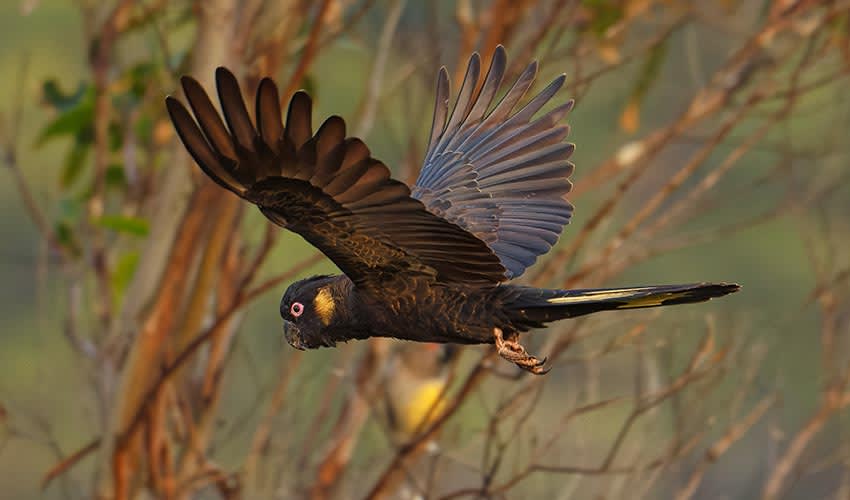
One of Australia’s most impressive and easily recognized birds, admired for its size, striking colors, and powerful presence. Its feathers are a deep charcoal black, highlighted by bright yellow panels on the sides of its tail and bold yellow cheek patches that glow against the dark plumage. Long wings and a large wingspan give it a slow, sweeping flight style, often accompanied by loud, wailing calls that carry far across forests and open landscapes. When seen gliding overhead or perched high in a tree, this cockatoo leaves a strong and lasting impression.
This species is highly adaptable and can be found across a wide range of habitats, including forests, woodlands, coastal areas, and even near cities. Yellow-tailed black cockatoos feed on a varied diet of seeds, nuts, fruits, and insects, using their strong beaks to break open tough seed pods and strip bark in search of grubs. They are particularly skilled at finding wood-boring insects, leaving behind distinctive chew marks on tree trunks and branches. These feeding habits help control insect populations and contribute to the health of forest ecosystems.
Yellow-tailed black cockatoos are social birds and are often seen in small groups or family units, though larger flocks may gather when food is abundant. They are highly vocal, using a range of calls to communicate with one another while flying or feeding. Mated pairs form strong bonds and often stay together for many years.
One of the most charming aspects of the yellow-tailed black cockatoo is its intelligence and playful behavior. These birds are curious and observant, sometimes stopping to inspect new objects or activities below them. They may hang upside down while feeding, interact noisily with flock members, or engage in gentle play. Their expressive movements and vocal nature make them fascinating to watch, whether they are feeding quietly or calling loudly from treetops.
Distribution
 Australia
Anything we've missed?
Help us improve this page by suggesting edits. Glory never dies!
Suggest an editGet to know me
Terrestrial / Aquatic
Altricial / Precocial
Polygamous / Monogamous
Dimorphic (size) / Monomorphic
Active: Diurnal / Nocturnal
Social behavior: Solitary / Pack / Flock
Diet: Carnivore / Herbivore / Omnivore / Piscivorous / Insectivore
Migratory: Yes / No
Domesticated: Yes / No
Dangerous: Yes / No




