Allochrocebus – Terrestrial guenons
Because they live primarily on the ground, they exhibit more dog-like movements than typical monkeys
Once grouped with the tree-dwelling Cercopithecus guenons, Allochrocebus was later recognized as a distinct genus based on genetic, behavioral, and ecological differences. These monkeys are found primarily in the forests and montane regions of Central and East Africa, where they inhabit the shaded forest floor rather than the upper canopy. This is a group of small but remarkable primates that illustrate how intelligence, cooperation, and adaptability can thrive even in the dim undergrowth of Africa’s forests.
Physically, terrestrial guenons share a similar body plan with other guenons but are generally more robust and short-limbed, reflecting their mostly ground-based lifestyle. Their fur is typically dark brown or black, accented by distinctive markings that vary by species. The L’Hoest’s monkey, for example, has a velvety black face framed by a white ruff and a chestnut-brown back, while the Preuss’s monkey features a darker coat and a grayish-blue face. The rare sun-tailed monkey, found only in Gabon, has a rich golden-brown tail and softer, reddish fur. These striking color patterns, combined with their expressive faces and intelligent eyes, give them an air of quiet dignity as they move through the forest shadows.
Unlike most guenons that leap among branches, terrestrial guenons spend much of their time on the ground, foraging in leaf litter for fruits, seeds, insects, and small animals. Their diet is highly varied and opportunistic—they feed on fallen fruit, dig for roots and fungi, and skillfully capture insects and small invertebrates. This ground-based feeding behavior helps recycle nutrients and disperse seeds, making them important ecological players in their forest ecosystems. Despite their terrestrial habits, they still climb trees to sleep or escape danger, showing a flexibility that helps them survive in environments where predators like leopards, eagles, and forest cats lurk.

Species in this genus


Preuss’s monkey
Prefer mid-level forest layers, where they leap confidently between vines and branches

L’Hoest’s monkey
Its bright white throat patch looks like a fluffy beard — giving it one of the most distinctive faces in the monkey world
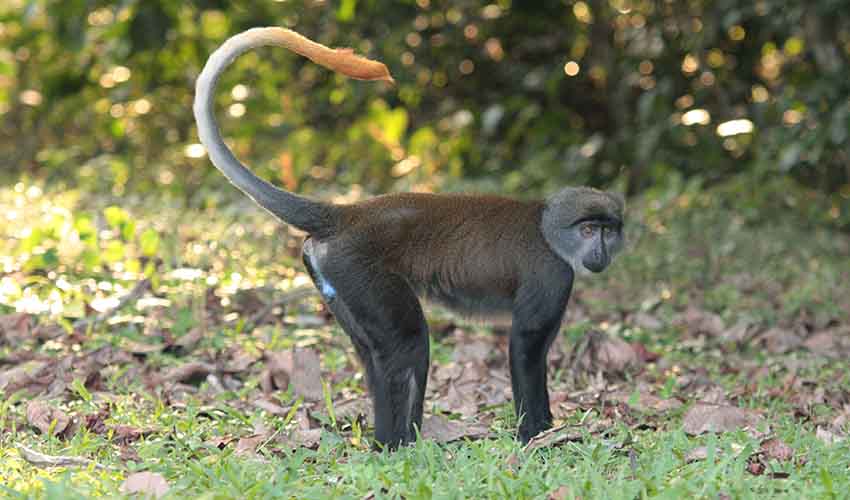
Sun-tailed monkey
So elusive that it went undiscovered by science until the late 20th century

