


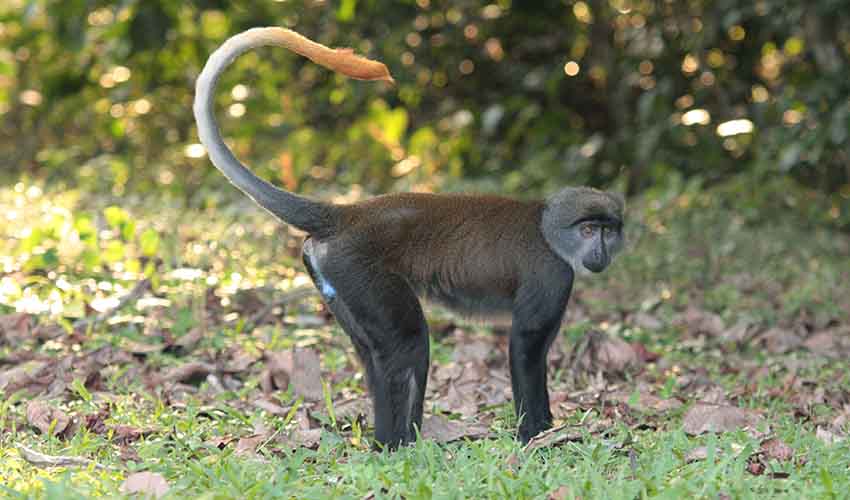
Discovered only in 1984, it is among the newest primates to be described by science and remains one of the least studied. Known for its rich golden-brown tail, gentle nature, and secretive habits, the sun-tailed monkey is a jewel of the African forest—a living reminder that even today, the world still holds hidden species waiting to be understood.
True to its name, the tail is its most distinctive feature—golden-brown to reddish in color, contrasting beautifully with its otherwise dark grayish or olive-brown coat. Its face is framed by soft gray fur, with expressive brown eyes and a small, narrow muzzle that gives it a calm, alert look. Like other guenons, it has cheek pouches for storing food and a lean, agile body built for both climbing and walking. Its hands and feet are strong and dexterous, allowing it to move gracefully across tree roots and fallen logs in the dim understory of its forest home. The combination of its warm tail and dusky body creates a soft, glowing effect in the filtered sunlight—one of the reasons for its evocative name.
The sun-tailed monkey is endemic to Gabon, meaning it is found nowhere else on Earth. Its range is confined mainly to the Lopé National Park and surrounding forests in central Gabon, an area of humid lowland and montane rainforest. It is one of the few African primates that prefers life close to the ground, a behavior typical of its genus.
While most guenons leap among the treetops, the sun-tailed monkey spends much of its time foraging on the forest floor, searching for fallen fruits, seeds, young leaves, fungi, and insects. It occasionally climbs into low branches to pluck fruit or rest, but its movements are calm and deliberate rather than acrobatic. This semi-terrestrial lifestyle is well-suited to the thick, tangled forests it inhabits, where visibility is low and silence offers safety from predators such as eagles, leopards, and pythons.
Distribution
 Gabon
GabonAnything we've missed?
Help us improve this page by suggesting edits. Glory never dies!
Suggest an editGet to know me
Terrestrial / Aquatic
Altricial / Precocial
Polygamous / Monogamous
Dimorphic (size) / Monomorphic
Active: Diurnal / Nocturnal
Social behavior: Solitary / Pack / Herd
Diet: Carnivore / Herbivore / Omnivore / Piscivorous / Insectivore
Migratory: Yes / No
Domesticated: Yes / No
Dangerous: Yes / No




