Botaurus
They fluff or sleek their feathers to subtly change outline — like reed-shaped shapeshifters
Includes the secretive, slow-moving, and surprisingly dramatic bitterns — large, heavy-bodied herons famous for their deep, booming calls that echo across marshes like someone blowing into a giant bottle. Found in marshes, reedbeds, and wetlands across parts of North America, Europe, Asia, and Australasia, these birds are masters of disappearing in plain sight. Their plumage is streaked in browns, tans, and blacks, perfectly mimicking reeds and cattails. When danger appears, they perform their famous “bittern pose”: standing tall, bill pointed skyward, body frozen, swaying gently to match the movement of grasses. It’s camouflage so convincing that predators — and people — often walk right by without noticing.
Bitterns in this genus include well-known species like the American bittern and the Eurasian bittern, as well as the Australasian and Australasian little bittern. All share a secretive lifestyle. Rather than patrolling open shallows like other herons, they lurk among thick vegetation, stalking frogs, insects, small fish, and even mice with slow, calculated steps. Their hunting style is patient and quiet — more ninja than spear-angler. During breeding season, males create an unexpected spectacle: they produce a hollow, resonant boom by gulping air and vibrating their throat muscles, a sound that can carry for kilometers over still water at dawn. Wetland dawn choirs wouldn’t be the same without that mysterious fog-shrouded bass note.
Nesting behavior is just as marsh-bound. Females build hidden platform nests of reeds and grasses close to water and raise their downy chicks in near-total seclusion. Young bitterns quickly master the “freeze” trick too — when alarmed, they point their tiny bills skyward like miniature reed stalks. Because they rely so heavily on dense wetlands, Botaurus bitterns are good indicators of the health of freshwater habitats. In places where wetlands dry up, become polluted, or are drained, bittern numbers often fall. In contrast, where habitats are restored — such as reedbed rehabilitation projects in parts of Europe — these shy birds have made encouraging comebacks.

Species in this genus
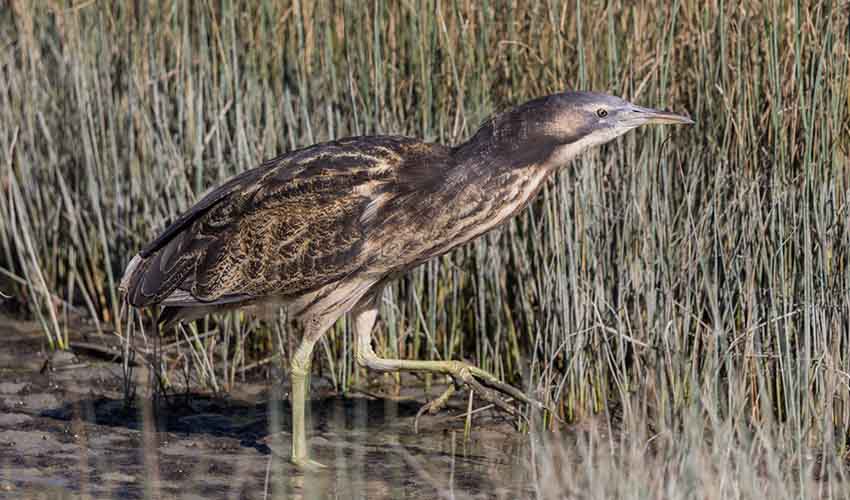


Australasian bittern
Its streaky brown feathers match reeds so well that it can be nearby and still look like part of the vegetation

Von Schrenck’s bittern
When alarmed, it often points its bill straight up and stays still so it looks like just another reed stalk

Eurasian bittern
Its boom has been compared to blowing across the top of a giant bottle — a sound low enough to feel in your chest on still mornings

