


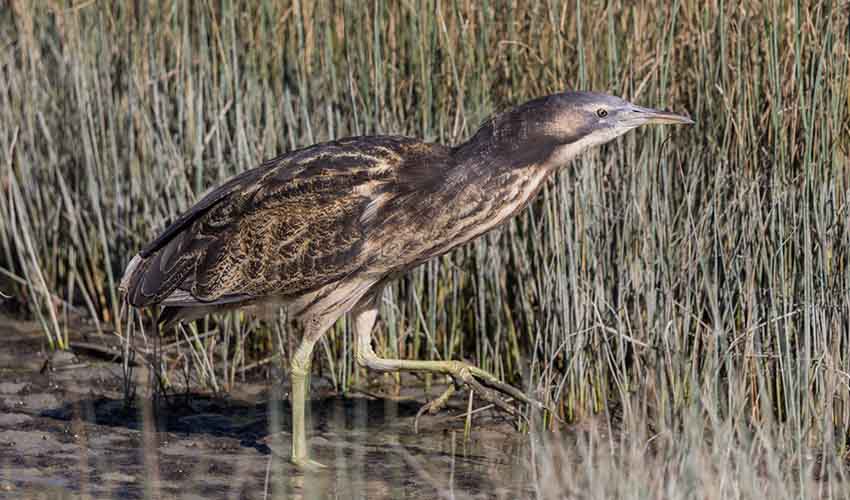
A secretive wetland bird that many people never see, even if it lives nearby. It’s found in Australia, New Zealand, and nearby islands, and it belongs to the heron family. But unlike the tall, obvious herons that stand in open water, this bird is a master of hiding. Its feathers are patterned in streaky browns, buffs, and dark lines that match reeds, grasses, and muddy wetland plants almost perfectly. When it senses danger, it often freezes in place with its bill angled upward, blending into the upright stems around it.
What makes the Australasian bittern different from many other wetland birds is its preference for thick cover and its shy, slow-moving style. It lives in reed beds, marshes, and wetlands with dense vegetation, where it can walk quietly through shallow water without being noticed. Instead of flying around often, it relies on patience, stillness, and camouflage. Its body is compact but sturdy, and its neck can stretch out suddenly when it needs to strike at prey. When it does fly, it tends to lift off with a heavy, powerful effort and then travel low over the reeds before dropping back into cover.
The Australasian bittern hunts like a stealthy ambush predator. It feeds on fish, frogs, insects, and other small wetland animals. A typical hunt looks almost like a statue coming to life: the bird stands still, watching the water, then snaps forward with a quick jab when something moves within reach. In cluttered wetlands, where stems and floating plants make movement tricky, this method works well. The bittern can also forage by slowly stalking through shallow water, pausing often and using its sharp eyes to track tiny movements. Because it is most active around dawn and dusk, it often avoids the brightest parts of the day, which helps it stay hidden from predators and people.
Distribution
 Australia
 New Caledonia
 New Zealand
Anything we've missed?
Help us improve this page by suggesting edits. Glory never dies!
Suggest an editGet to know me
Terrestrial / Aquatic
Altricial / Precocial
Polygamous / Monogamous
Dimorphic (size) / Monomorphic
Active: Diurnal / Nocturnal
Social behavior: Solitary / Pack / Herd
Diet: Carnivore / Herbivore / Omnivore / Piscivorous / Insectivore
Migratory: Yes / No
Domesticated: Yes / No
Dangerous: Yes / No




