Chlamydoselachidae – Frilled sharks
Their bodies are so snake-like that they are often mistaken for sea serpents, which may explain ancient monster legends.
These sharks are often called “living fossils” because their overall shape and behavior have remained almost unchanged for tens of millions of years. Frilled sharks do not look like the sharks most people imagine. Instead of a strong, compact body built for speed, they have long, slender bodies that resemble eels or snakes. This gives them a haunting, prehistoric appearance, especially when combined with their dark skin and expressionless eyes. Their name comes from the frilly edges of their gill slits, which form a ruffled collar around the throat.
One of the most striking features of frilled sharks is their mouth and teeth. Their jaws are lined with many rows of sharp, needle-like teeth that curve inward, creating a natural trap for prey. Unlike sharks that rely on powerful bites or speed, frilled sharks use a sneakier approach. They often float quietly in the deep ocean, waiting for the right moment to strike. When prey comes close, they suddenly lunge forward, opening their mouths wide and snapping shut in one quick motion. Their flexible jaws allow them to swallow prey that is surprisingly large compared to their body size. This hunting style, combined with their slow and graceful movement, makes them very different from fast, aggressive hunters like tiger sharks or great whites.
Members of the Chlamydoselachidae family prefer deep waters, often hundreds or even thousands of meters below the surface. This environment is dark, cold, and quiet, and it has shaped the way these sharks live. Their slow movements help them conserve energy in a place where food is not always easy to find. They mainly feed on squid, small fish, and other deep-sea animals. Because they live so far below the surface, humans rarely encounter them, which adds to their mystery. When a frilled shark is accidentally caught or seen near the surface, it often draws a lot of attention because of how strange and ancient it looks.

Genera in this family
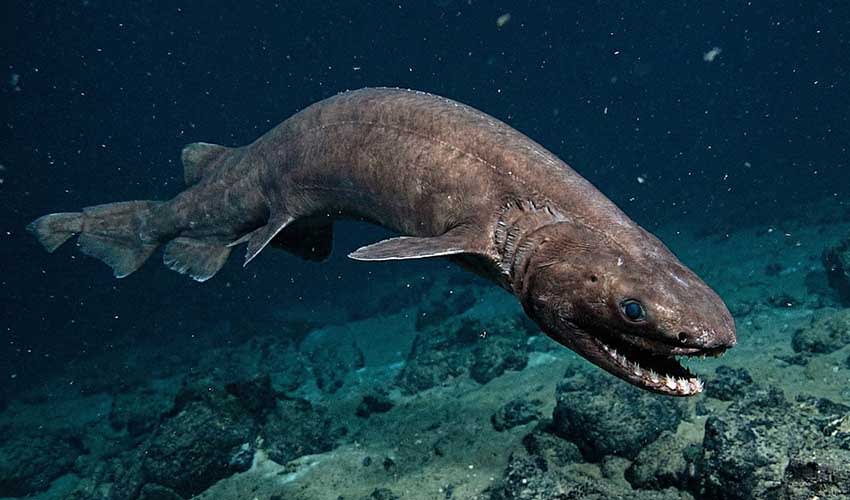


Often called “living fossils” because their design has barely changed for millions of years

