Chlamydoselachus
Often called “living fossils” because their design has barely changed for millions of years
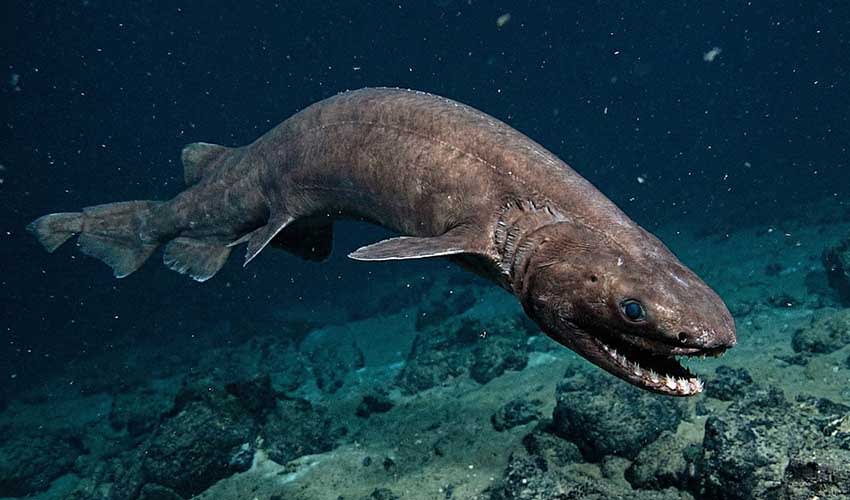
Represents one of the most unusual and ancient-looking sharks still living in today’s oceans. These sharks are often described as living fossils because their appearance has changed very little over millions of years. At first glance, Chlamydoselachus hardly looks like a shark at all. Its long, slender body resembles that of an eel or snake, giving it a ghostly, almost mythical appearance as it moves through the water. Its skin is dark brown or gray, helping it blend into the deep, shadowy waters it calls home. One of its most recognizable features is the series of frilly gill slits around its neck, which form a ruffled collar and give the shark its common name.
Another feature that sets Chlamydoselachus apart is its mouth and teeth. Instead of having flat, cutting teeth like many well-known sharks, it has hundreds of thin, needle-like teeth arranged in multiple rows. These teeth curve inward, acting like hooks that prevent prey from escaping once caught. This design is especially useful for gripping slippery animals such as squid. Unlike fast-swimming sharks that rely on speed and force, Chlamydoselachus uses patience and surprise. It often floats quietly in the water, barely moving, before suddenly lunging forward to catch its prey. Its jaws can open wide, allowing it to swallow animals much larger than its own body.
The deep-sea lifestyle of Chlamydoselachus plays a major role in shaping its behavior and appearance. These sharks are usually found far below the ocean’s surface, where sunlight barely reaches, and temperatures are low. In this environment, food can be hard to find, so conserving energy is important. The slow movements of Chlamydoselachus help it survive in such conditions. Its flexible body allows it to move smoothly along the ocean floor and through narrow spaces where prey may hide. Because these sharks live so deep, humans rarely encounter them, and much of their life remains a mystery.
Species in this genus


Frilled shark
Looks so much like a snake that it is sometimes called the “sea serpent shark”

