Eleothreptus
When they sit on the ground, they look like bits of dried grass and earth
At first glance, Eleothreptus nightjars look like classic nightjars: soft gray-brown plumage, wavy patterns, and big dark eyes made for low light. Look closer, though, and their special features jump out. The white-winged nightjar gets its name from the male’s dramatic white patches in the wings and tail, which flash like signals when he flies in display at dusk. Females, by contrast, are buffy and much more camouflaged, with no white at all in their feathers. The sickle-winged nightjar is named for the male’s oddly shaped outer wing feathers, which curve to give the wing a hooked, “sickle” outline in flight. Females lack those specialized feathers and are browner overall, blending perfectly into the ground when they sit still.
Geographically, Eleothreptus is a South American specialist. White-winged Nightjars are known from just a handful of scattered sites in Bolivia, Brazil, and Paraguay, where they live in open grasslands and in a type of dry savanna with scattered shrubs and trees called cerrado. Sickle-winged nightjars are found in southern Brazil, Paraguay, and northeastern Argentina, and probably also occur in neighboring Uruguay, though that still lacks confirmed records. Both species favor low, open country rather than dense forest, and both are thought to be mostly resident, perhaps making only short seasonal shifts. Unfortunately, their preferred habitats are also among the most heavily altered in South America, with huge areas of cerrado and native grassland converted to pasture, crops, and tree plantations.
Sickle-winged Nightjars hunt in a different style, making short flights from the ground or low perches such as fence wires, flying with slow, fluttering wingbeats and gliding to catch insects in the air. Their song is a series of soft “chip” or “tchut” notes, sometimes described as cricket-like, repeated for long periods on calm nights. Like most nightjars, both species lay their eggs directly on the ground, with no real nest, relying on camouflage to hide them.

Species in this genus
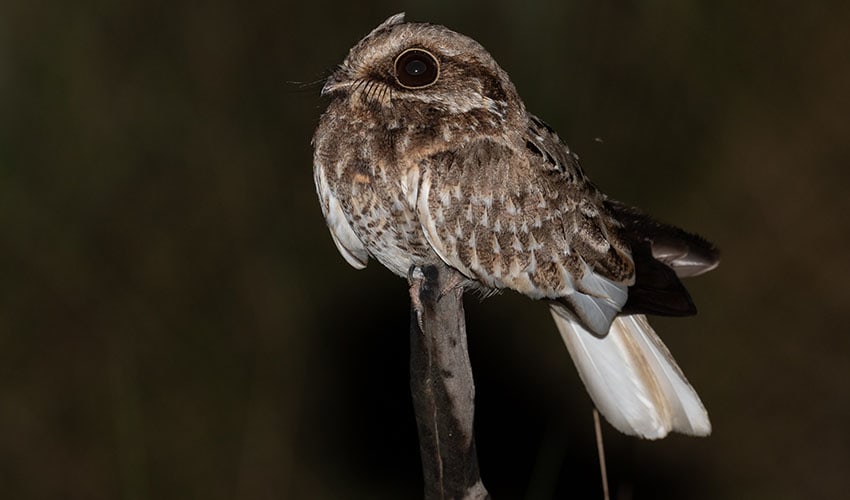


White-winged nightjar
One of the “shiniest” nightjars

