Eurylaimus
Increasingly threatened by deforestation, logging, and fragmentation of Southeast Asia’s rainforest
Found in the lush rainforests of Southeast Asia, these birds seem like living jewels among the green canopy. Their name comes from Greek roots meaning “broad throat,” a nod to their large, flattened bills, which give them a perpetually curious, almost comical expression.
These broadbills are small to medium-sized birds with stout bodies and short tails, but what they lack in size, they make up for in style. The banded broadbill is a painter’s dream—draped in shades of deep purple, black, and gold, with bright turquoise bill and legs that look as if they’ve been dipped in sky-blue paint. The black-and-yellow broadbill, on the other hand, sports a striking contrast of inky black wings and lemon-yellow body, framed by a glowing pinkish chest band. Both species carry a glossy sheen that glitters in dappled sunlight, making them some of the most photogenic birds in the Asian tropics.
But these birds are not just pretty faces—they’re clever and capable hunters. Their oversized bills are perfectly designed to snatch up large insects from midair or pluck them off leaves with precision. They also eat small frogs, lizards, and even fruit, showing off their adaptable appetites. Broadbills spend most of their time high in the forest canopy, moving in pairs or small family groups, calling to each other with melodious whistles and trills. Their songs echo through the forest like soft flute notes, often mistaken for insect calls or distant water trickles. When it’s time to nest, both parents join forces to build a hanging, pear-shaped nest, woven from vines, moss, and leaves, usually suspended from the end of a high branch over a stream. The nest’s entrance sits on the side or bottom, a clever defense against predators.

Species in this genus
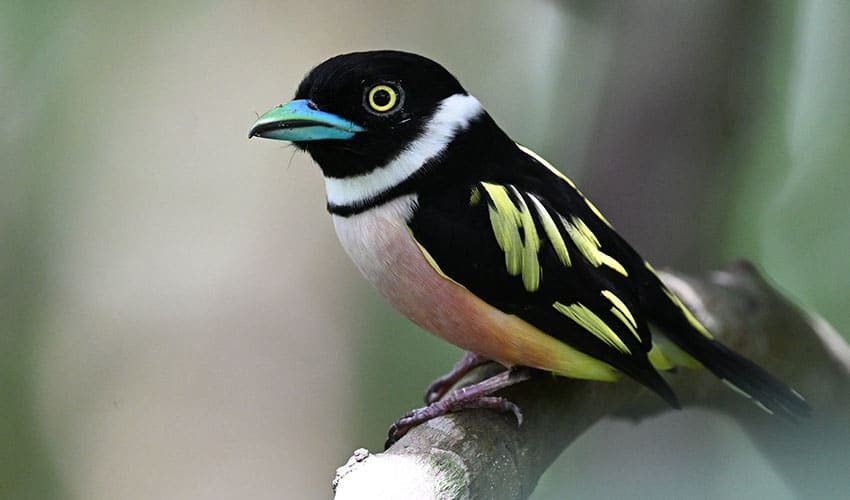


Black-and-yellow broadbill
Its bright turquoise bill actually seems to glow in the dim forest light, a rare trait among birds

