


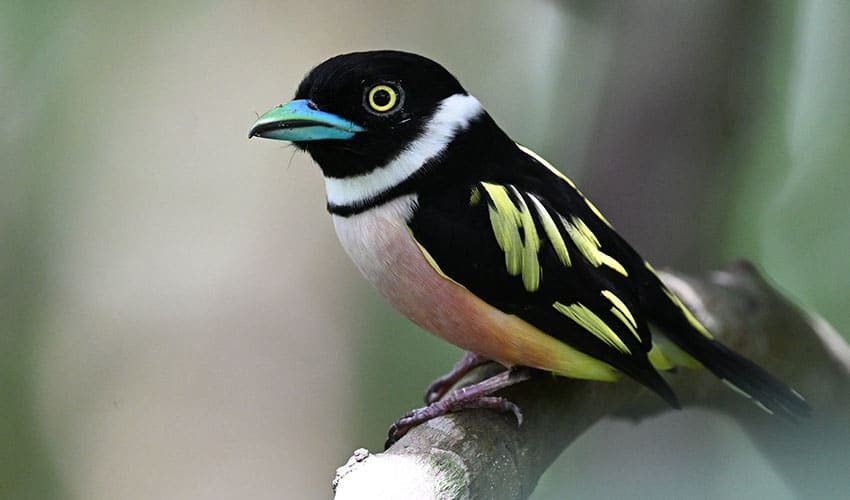
One of the most dazzling birds in Southeast Asia’s forests, appearing almost like a superhero in bright colors perched among the green canopy. Found in countries such as Malaysia, Thailand, Indonesia, Brunei and Myanmar, this small but eye-catching bird thrives in lowland evergreen forest, swamp forest and even some plantations—so long as big trees and intact canopy remain.
Visually, it is unforgettable. The adult male sports a jet-black head with a crisp white collar, lemon-yellow streaks on its back and wings, and underparts that shift from wine-pink to a soft yellow belly. Its huge, broad bill glows bright turquoise-blue with a green tip—so striking that you’d spot it even in a dim jungle understory. Females are slightly less bold: the black breast-band is often incomplete, and their colors may be a little more muted.
Behaviourally, the black-and-yellow broadbill is as interesting as it is beautiful. It feeds mainly on large insects—grasshoppers, mantises, beetles—snatching them from perches or dashing out in short flights. Occasionally it eats molluscs or soft fruit. It tends to move in pairs or small family groups and is not overly shy; but despite its bright colors, it remains remarkably hard to see because its plumage blends with dappled light and shadow in the canopy.
One of its most fascinating traits is the nest. Both male and female work together to build a large, pear-shaped, hanging nest, woven from moss, fungal threads and leaves, often suspended from a high branch over a clearing or stream. The entrance sits on its side or bottom—an ingenious design that helps protect against predators and rain. When these broadbills call, the sound is a bubbling, cicada-like trill that rises and falls for 8–12 seconds, frequently in alternating duets between pairs.
Distribution
 Brunei
 Indonesia
 Malaysia
 Myanmar
 Singapore
 Official estimate
 Thailand
Anything we've missed?
Help us improve this page by suggesting edits. Glory never dies!
Suggest an editGet to know me
Terrestrial / Aquatic
Altricial / Precocial
Polygamous / Monogamous
Dimorphic (size) / Monomorphic
Active: Diurnal / Nocturnal
Social behavior: Solitary / Pack / Herd
Diet: Carnivore / Herbivore / Omnivore / Piscivorous / Insectivore
Migratory: Yes / No
Domesticated: Yes / No
Dangerous: Yes / No




