Monodelphis – Short-tailed opossums
Don’t have a true pouch—babies cling to nipples and skin folds instead
Unlike many opossums that are famous for climbing, these are mostly terrestrial—built to live in leaf litter, under logs, and along the forest floor. They have compact bodies, pointed snouts, and small ears, and their tails are noticeably short compared with most other opossums. That short tail is exactly what gives the group its common name, and it hints at how they live: more running, digging, and slipping through ground cover than balancing on branches. Their fur varies by species—often gray, brown, or reddish—usually with paler undersides, and some species have bolder patterns or richer colors that make them surprisingly handsome for such secretive animals.
What distinguishes Monodelphis from many other opossums is that most species have no true pouch. Instead of a deep pouch, the mother has folds of skin and nipples that the tiny newborns cling to. That creates a very different mental picture of “marsupial parenting”: rather than disappearing into a pouch, the babies are more exposed, attached closely as they develop. Another standout difference is their shape and attitude. Many Monodelphis species look almost “shrew-like” in posture—low, quick, and purposeful—more like small hunters than scavengers. People who only know the big opossums that roam roadsides are often surprised by how sleek and predator-like these can seem.
Short-tailed opossums are generally nocturnal or most active in low light, using smell and hearing to track tiny prey in the leaf litter. Insects are a big part of the menu, but they can also take other small animals, depending on what’s available and what size the species is. They move with a quick, searching pattern—nose close to the ground, pausing to sniff, then darting forward to investigate a rustle. Because they spend so much time on the forest floor, they rely heavily on cover. They disappear under leaves, into root tangles, or inside rotten logs, and they often use the same kinds of sheltered micro-habitats again and again.

Species in this genus
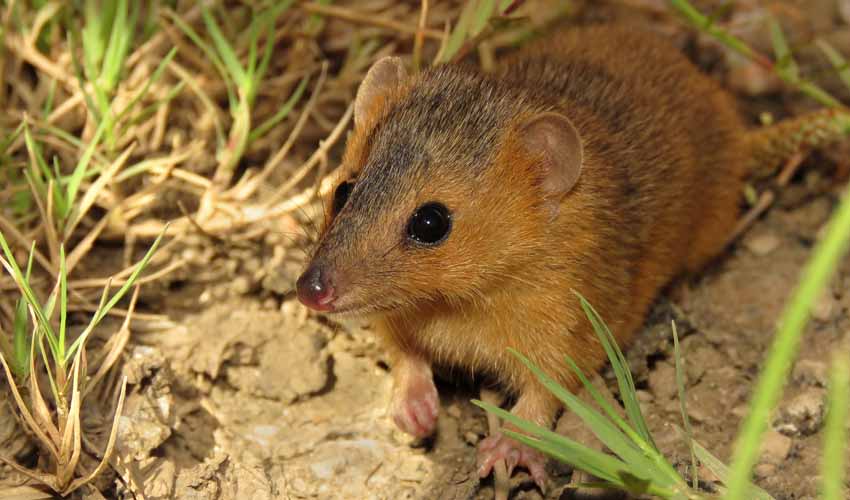


Yellow-sided opossum
More “mouse-sized wolf” than “trash opossum”

