


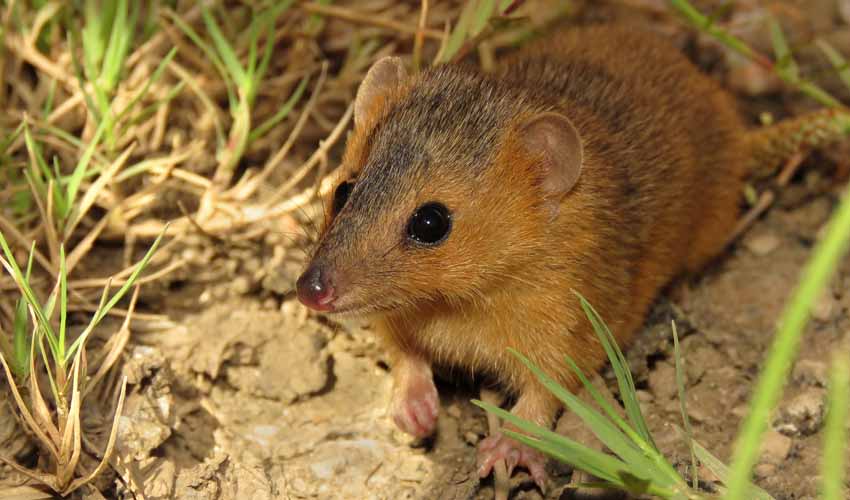
A small South American marsupial that looks like it’s wearing a two-tone jacket made for grassland shadows. Its back is usually gray to dark gray, while its sides glow with warm yellow-orange fur that can run all the way down the legs to the feet—almost like someone brushed it with sunset-colored paint. Unlike many opossums people imagine, it doesn’t have the long, ropey tail built for constant climbing. Its tail is shorter and sturdier, fitting a ground-focused life in grasses and low cover rather than a life spent balancing in treetops.
The yellow-sided opossum is one of the rare mammals that typically breeds only once and then dies soon after, making its life feel like a fast, intense sprint rather than a slow marathon. That annual rhythm shapes everything: it grows up quickly, reaches maturity, mates, and then many adults are gone by the next season. It also shows big differences between males and females. Adult males are much larger, and they often have very noticeable canine teeth—big enough that, if you saw one up close, you might be shocked that such a small animal can look so fierce. In fact, this species has been compared to a “mini sabertooth” because its canines are huge for its body size, giving it a surprisingly predator-like look.
Behavior-wise, it’s a ground-level problem-solver with clever feeding tricks. It hunts insects and other small animals, and it doesn’t always grab prey the same way. For example, it may rush large insects quickly and start at the head, but if it encounters a hairy caterpillar, it can scratch at it first to remove irritating hairs before eating—like it’s “prepping” its meal to make it safer. It can also chase and pin down very small vertebrates with a bite that targets the neck, which is an intense strategy for such a tiny marsupial
Distribution
 Argentina
 Brazil
 Paraguay
 Uruguay
Anything we've missed?
Help us improve this page by suggesting edits. Glory never dies!
Suggest an editGet to know me
Terrestrial / Aquatic
Altricial / Precocial
Polygamous / Monogamous
Dimorphic (size) / Monomorphic
Active: Diurnal / Nocturnal
Social behavior: Solitary / Pack / Herd
Diet: Carnivore / Herbivore / Omnivore / Piscivorous / Insectivore
Migratory: Yes / No
Domesticated: Yes / No
Dangerous: Yes / No




