Morus – Gannets
They “fly” underwater with wing strokes, using their streamlined bodies like submarines
These birds are found across the North Atlantic and southern oceans, where wind, waves, and cold currents shape their world. The three living species — the Northern gannet, Cape gannet, and Australasian gannet — all share a similar blueprint: sleek white bodies, long pointed wings, dagger-like bills, and striking facial markings around pale, piercing eyes. Their plumage, often tinged with warm golden tones on the head, gives them a somewhat regal look, especially in breeding season when feathers become crisp and bright.
Gannets are built for speed, endurance, and precision hunting. They patrol coastal waters and open ocean in search of fish, then fold their wings and plunge like feathered javelins from heights that can exceed 30 meters (100 feet). Hitting the water at speeds over 60 km/h (37 mph), they use specialized skulls, air sacs, and reinforced muscles to withstand impact — adaptations that allow them to pursue fish underwater with powerful strokes. Watching a feeding flock of gannets plunge in unison is one of the great wildlife spectacles of the sea; foam flies, birds vanish into the surf, and moments later they burst upward again like streamlined torpedoes returning to the air.
Life for gannets is strongly colony-based. They nest on steep cliffs, rocky islands, and windswept headlands, forming dense, noisy, and highly social breeding sites that can number in the tens of thousands. Pairs form long-term bonds, reinforcing their connection through mutual preening and ritualized displays. A single egg is laid, and both parents share incubation and chick-rearing duties. Young gannets leave the colony after months of growth, often launching themselves off cliffs into the sea below — a literal leap into independence. Their first flight and first swim are the same moment, a dramatic start to a life spent largely offshore.

Species in this genus
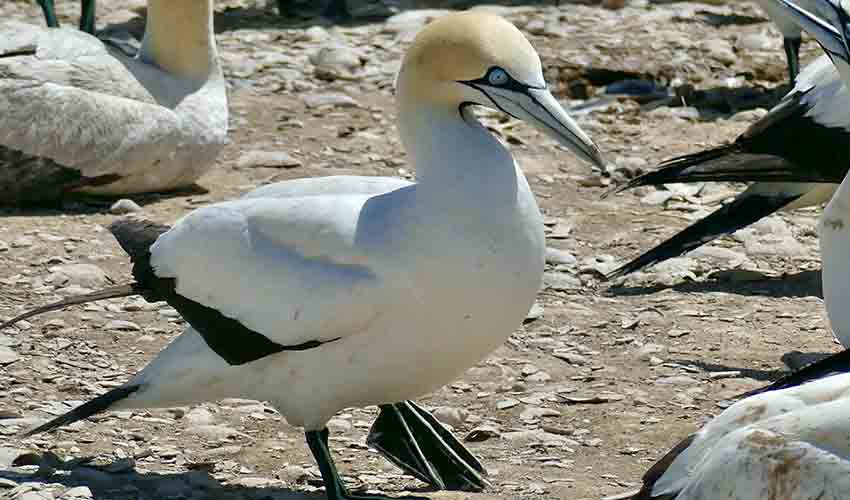


Cape gannet
That bright blue eye ring makes their gaze especially striking

Northern gannet
Superb gliders and can travel hundreds of kilometers in a day, riding winds with barely a wingbeat

