


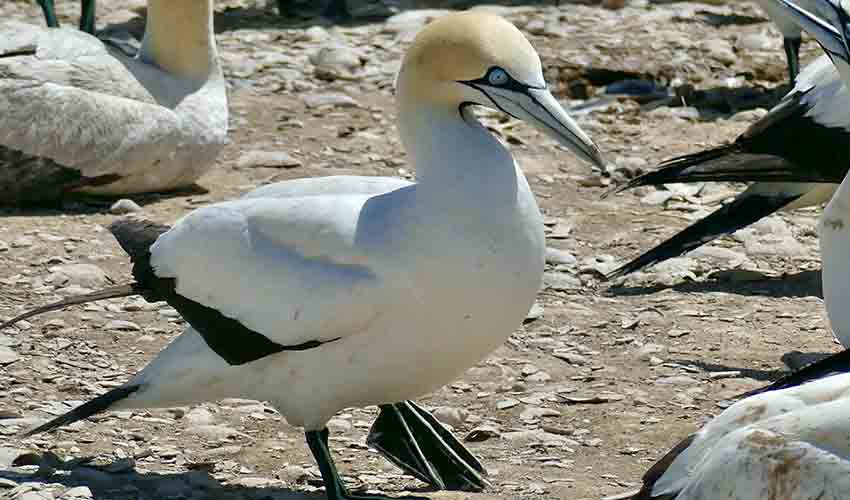
A striking seabird native to the southern coasts of Africa, especially around Namibia and South Africa. Instantly recognizable, it has a clean white body contrasted by jet-black wing tips and tail, creating a bold pattern that stands out against the ocean and sky. Its long, pointed wings and streamlined body are perfectly shaped for life at sea. The head has a pale golden wash, and its eyes are surrounded by a distinctive blue ring, giving the bird an alert and almost intense expression.
One of the most remarkable characteristics of the Cape gannet is its dramatic feeding style. It is a plunge diver, meaning it hunts by flying high above the ocean and then diving straight down at incredible speed. Folding its wings tightly against its body, the bird hits the water like a spear, sometimes entering from heights of over 30 meters (98 feet). Special air sacs in its face and chest help cushion the impact, protecting it from injury.
Cape gannets are highly social birds, especially during the breeding season. They nest in large, dense colonies on offshore islands and rocky coastal cliffs. These colonies can contain tens of thousands of birds packed closely together, creating a noisy and energetic environment. Each pair forms a strong bond, and mates often greet each other with ritualized displays that include bill fencing, head shaking, and mutual calling. Nests are simple, made from guano and small bits of debris, but they are fiercely defended from neighboring birds.
Another trait that sets the Cape gannet apart from many seabirds is its strong connection to cold, nutrient-rich waters. It relies heavily on schooling fish, and its movements are closely linked to ocean conditions. Outside the breeding season, Cape gannets may travel long distances along the coast in search of food. They are powerful flyers, able to glide smoothly just above the waves for long periods, conserving energy while scanning the water below.
Distribution
 Angola
 Brazil
 Cameroon
 Congo-Brazzaville
 DR Congo (Kinshasa)
 Equatorial Guinea
 Gabon
Gabon Mozambique
 Namibia
 Nigeria
 South Africa
 São Tomé & Príncipe
 Togo
TogoAnything we've missed?
Help us improve this page by suggesting edits. Glory never dies!
Suggest an editGet to know me
Terrestrial / Aquatic
Altricial / Precocial
Polygamous / Monogamous
Dimorphic (size) / Monomorphic
Active: Diurnal / Nocturnal
Social behavior: Solitary / Pack / Flock
Diet: Carnivore / Herbivore / Omnivore / Piscivorous / Insectivore
Migratory: Yes / No
Domesticated: Yes / No
Dangerous: Yes / No




