Tolypeutes – Three-banded armadillos
Unlike most armadillos, they do not dig burrows, preferring to use natural shelters or the burrows of other animals
The genus name Tolypeutes derives from Greek words meaning “one who rolls up,” referring to their unique defense strategy. What distinguishes them from other armadillos is the presence of three movable bands across the midsection of the shell, allowing them to bend and fold themselves tightly. Their head and tail are shaped like interlocking shields that fit perfectly together when the animal curls up, creating a nearly impenetrable sphere. Their coloration ranges from pale yellow to reddish-brown, blending seamlessly with dry soils and savannas. Unlike many armadillos, they have short claws and strong legs but are not specialized diggers—they prefer using existing burrows or natural shelters rather than excavating their own.
Behaviorally, members of the genus Tolypeutes are solitary, nocturnal, and gentle, spending much of their time foraging for food at night. Their diet is mainly insectivorous, consisting of ants, termites, beetles, and larvae, but they also eat small fruits and roots when available. Using a long, sticky tongue, they lap up insects efficiently from soil or rotting wood. They rely on their keen sense of smell rather than sight to locate prey, since their small eyes and nocturnal habits limit vision. During the day, they rest in abandoned burrows, tree hollows, or dense vegetation, staying cool and safe from predators. When threatened, they perform their most iconic behavior: curling into a ball. In this state, the tough outer shell completely encloses their soft underparts, and the overlapping plates lock together so tightly that even powerful predators like jaguars or pumas cannot pry them open. This defensive posture is so effective that many animals lose interest after a few attempts, leaving the armadillo unharmed.

Species in this genus


Brazilian three-banded armadillo
One of the very few armadillos that can curl into a tight, almost perfect ball—most armadillos can’t fully “close” themselves
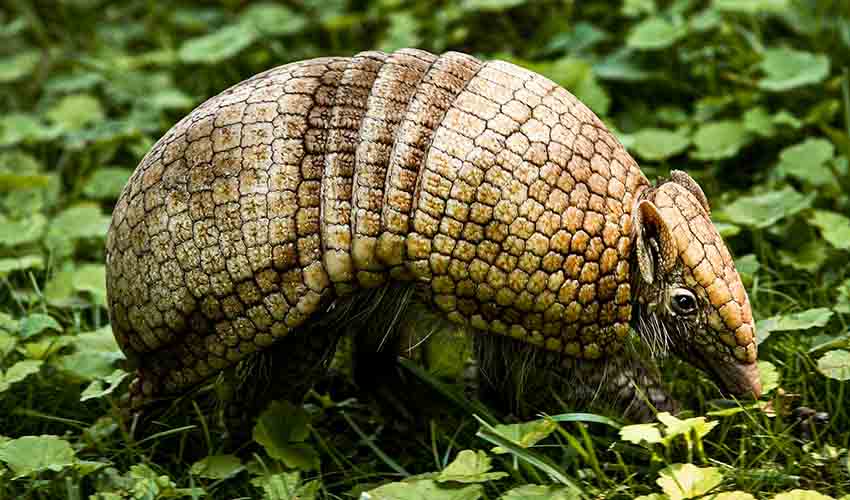
Southern three-banded armadillo
Often described as looking like a walking coconut!

