


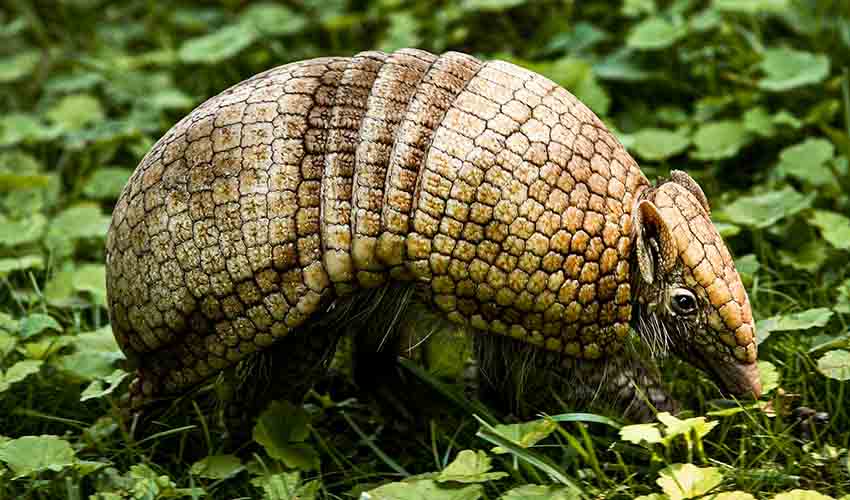
Native to the dry forests, grasslands, and savannas of Bolivia, Paraguay, northern Argentina, and parts of Brazil, this small, armored creature belongs to an elite group among armadillos: it’s one of only two species in the world capable of completely enclosing itself for protection.
The Southern three-banded armadillo has a smooth, domed shell made up of bony plates known as scutes, which are arranged in three movable bands across the middle of its body—hence the name “three-banded.” This structure gives the armadillo flexibility and allows it to perform its signature defense mechanism: completely curling into a tight ball. Its armor ranges in color from light tan to golden brown, blending perfectly with the sandy and dry environments it inhabits. Unlike many other armadillos, it has short limbs and small claws, since it doesn’t rely as heavily on digging for defense. Its head and tail are covered with thick, hard plates that fit together like puzzle pieces when it rolls up, forming an impenetrable sphere that can even withstand the bite of a jaguar.
Behaviorally, the southern three-banded armadillo is solitary and mostly nocturnal, spending its nights foraging for food and its days resting in burrows, hollow logs, or under dense vegetation. Its diet consists primarily of ants and termites, along with other small insects, fruits, and roots. Its long, sticky tongue can easily lap insects, while its keen sense of smell helps it locate prey beneath the soil or within rotting wood.
Unlike other armadillos that dig their own burrows, this species often takes advantage of abandoned burrows or natural shelters, conserving energy for foraging. Its movements are deliberate and cautious, and when threatened, it doesn’t flee but instead tucks its head and legs inside its shell and rolls into a ball—a strategy so effective that even powerful predators can do little more than nudge it around helplessly.
Distribution
 Argentina
 Bolivia
 Brazil
 Paraguay
Anything we've missed?
Help us improve this page by suggesting edits. Glory never dies!
Suggest an editGet to know me
Terrestrial / Aquatic
Altricial / Precocial
Polygamous / Monogamous
Dimorphic (size) / Monomorphic
Active: Diurnal / Nocturnal
Social behavior: Solitary / Pack / Herd
Diet: Carnivore / Herbivore / Omnivore / Piscivorous / Insectivore
Migratory: Yes / No
Domesticated: Yes / No
Dangerous: Yes / No




