


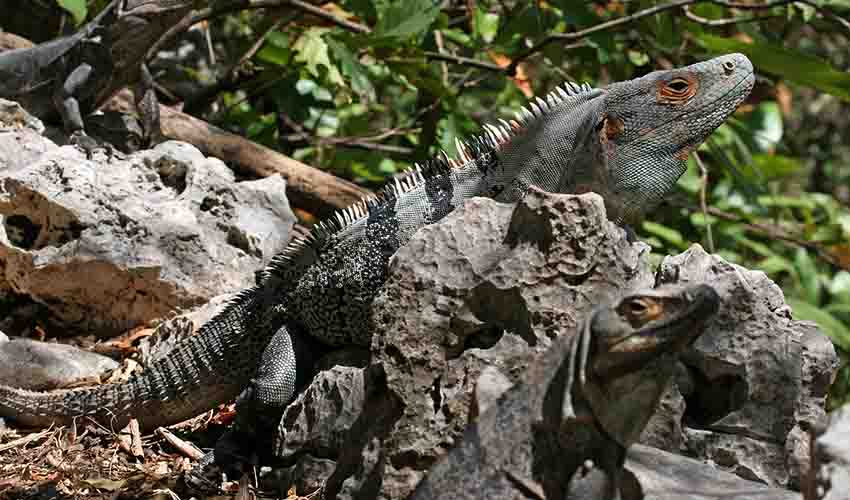
Native to Central America, from Mexico to Panama, this species is one of the most widespread and recognizable iguanas. It’s named for the row of sharp, dark spines running down its back and tail, which give it a rugged, armored look. Males are the real showstoppers: large, muscular, and often displaying a silvery-gray body with black bands or blotches. Females and juveniles are smaller and duller in color, but no less striking when you catch them basking on a sunlit wall or rock.
What makes the black spiny-tailed iguana truly special — and a bit of a legend — is its speed. It’s officially one of the fastest lizards in the world, clocking up to 21 miles per hour (34 km/h) in short bursts. That’s faster than most humans can sprint! This turbo-charged reptile relies on its agility to escape predators, often dashing into burrows or climbing trees with shocking ease. They’re also fantastic survivors: highly adaptable, these iguanas can thrive in forests, rocky hillsides, beaches, and even urban areas. You’ll often see them perched like royalty on ancient ruins, tree trunks, or sunny rooftops across Central America.
Black spiny-tailed iguanas are omnivorous opportunists. While they prefer leaves, fruits, and flowers, they’ll also eat insects, smaller reptiles, eggs, and even carrion if it’s available. Their flexible diet helps them succeed in nearly any environment. They’re also territorial, especially the males, who will bob their heads, puff up their throats, and flash their dark dewlaps to show dominance — or to impress the ladies. Despite their tough looks, these iguanas are vital to their ecosystems, helping spread seeds and control insect populations.
Distribution
 Belize
 Colombia
 Costa Rica
 El Salvador
 Guatemala
 Honduras
 Mexico
 Nicaragua
 Panama
 United States
 Venezuela
Anything we've missed?
Help us improve this page by suggesting edits. Glory never dies!
Suggest an editGet to know me
Terrestrial / Aquatic
Altricial / Precocial
Polygamous / Monogamous
Dimorphic (size) / Monomorphic
Active: Diurnal / Nocturnal
Social behavior: Solitary / Pack / Herd
Diet: Carnivore / Herbivore / Omnivore / Piscivorous / Insectivore
Migratory: Yes / No
Domesticated: Yes / No
Dangerous: Yes / No




