


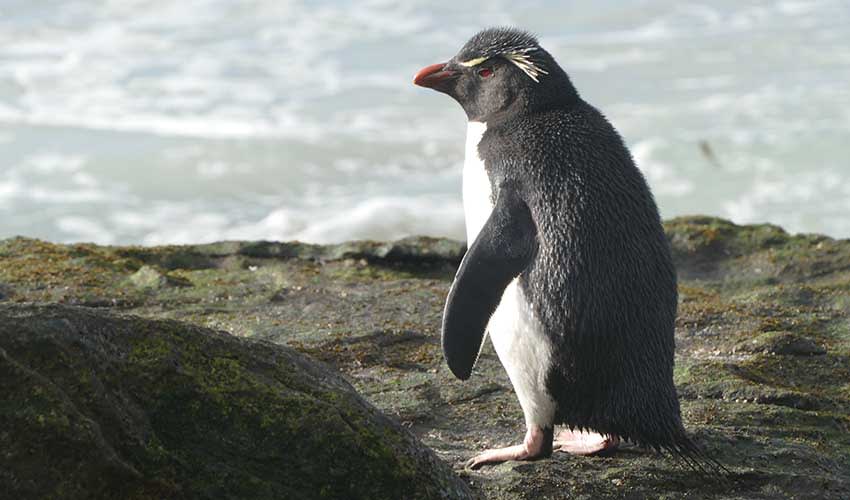
One of the most energetic and instantly recognizable penguin species in the world, famous for its wild yellow crest feathers and bold personality. Medium-sized and compact, it has a black back, white belly, and striking red eyes that give it an intense, almost mischievous expression. The long yellow feathers sprouting above each eye stick out like eyebrows in all directions, making the bird look permanently surprised or excited.
Unlike penguins that shuffle or slide across ice, rockhoppers live in rugged, rocky coastal areas and move by hopping from rock to rock, sometimes leaping several feet at a time. This hopping style is not just playful—it is necessary for climbing steep cliffs to reach nesting sites high above the sea. Compared to larger penguins, which rely on smoother terrain, Western rockhoppers thrive in harsh, uneven landscapes where few other animals can move easily.
Western rockhopper penguins are also extremely social and loud. They gather in large, bustling colonies where constant calls, squabbles, and displays fill the air. Their voices are sharp and braying, helping individuals recognize their mates among thousands of similar-looking birds. During the breeding season, they can appear surprisingly feisty, often arguing over nesting space or defending their partners with dramatic head-shakes and flipper flaps. Despite this noisy chaos, they form strong pair bonds and often return to the same partner and nest site year after year.
Western rockhopper penguins live mainly on islands in the southern Atlantic and Indian Oceans, often far from human settlements. Life there is tough, with strong winds, crashing waves, and limited shelter, yet these penguins thrive through teamwork and determination. Watching a group of Western rockhoppers leap out of the sea and scramble up cliffs in a blur of motion is both chaotic and captivating.
Distribution
 Antarctica
 Argentina
 Australia
 Chile
Chile Falkland Islands
 French Southern T.
Heard & McDonald
French Southern T.
Heard & McDonald New Zealand
 South Africa
Anything we've missed?
Help us improve this page by suggesting edits. Glory never dies!
Suggest an editGet to know me
Terrestrial / Aquatic
Altricial / Precocial
Polygamous / Monogamous
Dimorphic (size) / Monomorphic
Active: Diurnal / Nocturnal
Social behavior: Solitary / Pack / Flock
Diet: Carnivore / Herbivore / Omnivore / Piscivorous / Insectivore
Migratory: Yes / No
Domesticated: Yes / No
Dangerous: Yes / No




