


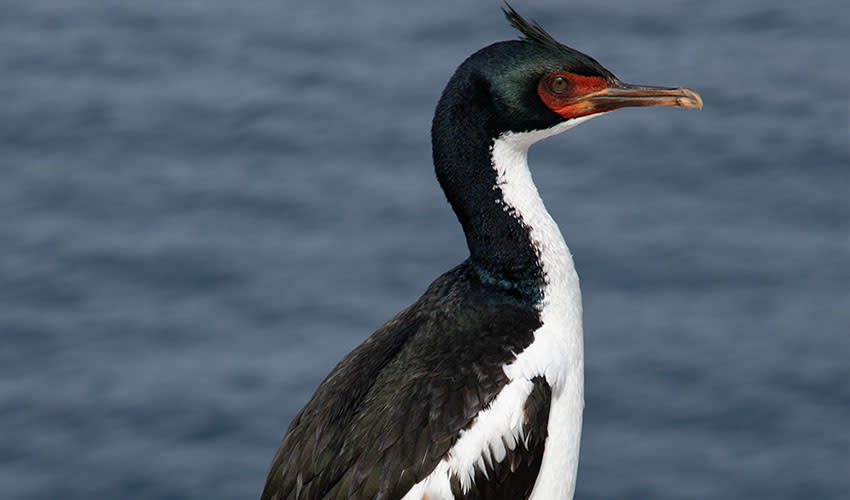
A rare and remarkable seabird found only in one of the most remote island groups on Earth: the Bounty Islands of New Zealand. These tiny, rocky islands lie far from the mainland and offer a harsh environment of steep cliffs, powerful winds, and rough seas. The Bounty shag has evolved to thrive in these extreme conditions, becoming perfectly adapted to life along wave-battered shores. Medium-sized and sturdy, this shag has a thick neck, a strong bill, and a compact body, giving it a powerful, resilient appearance.
One of the most striking features of the Bounty shag is its bold plumage. Adults have dark upperparts contrasted with white underparts and distinctive white facial markings that make them stand out against the dark rocks of their nesting sites. During the breeding season, these markings become even more noticeable, helping individuals recognize mates among crowded colonies. Like other shags, the Bounty shag has dense feathers that are not fully waterproof, which allows it to dive efficiently but requires it to dry its wings afterward. It is often seen perched on rocks, wings spread wide, in a familiar and iconic pose.
The Bounty shag is an excellent diver and relies heavily on the surrounding ocean for survival. It forages in coastal waters close to the islands, diving beneath the surface to catch fish. Using powerful strokes of its webbed feet, it can maneuver skillfully underwater, chasing prey through cold, turbulent seas. Its strong bill is well-suited for gripping slippery fish, and its keen eyesight helps it hunt effectively even in challenging conditions. These feeding skills are essential, as food availability can change quickly in such a remote environment.
Distribution
 New Zealand
 Official estimate
Anything we've missed?
Help us improve this page by suggesting edits. Glory never dies!
Suggest an editGet to know me
Terrestrial / Aquatic
Altricial / Precocial
Polygamous / Monogamous
Dimorphic (size) / Monomorphic
Active: Diurnal / Nocturnal
Social behavior: Solitary / Pack / Flock
Diet: Carnivore / Herbivore / Omnivore / Piscivorous / Insectivore
Migratory: Yes / No
Domesticated: Yes / No
Dangerous: Yes / No




