


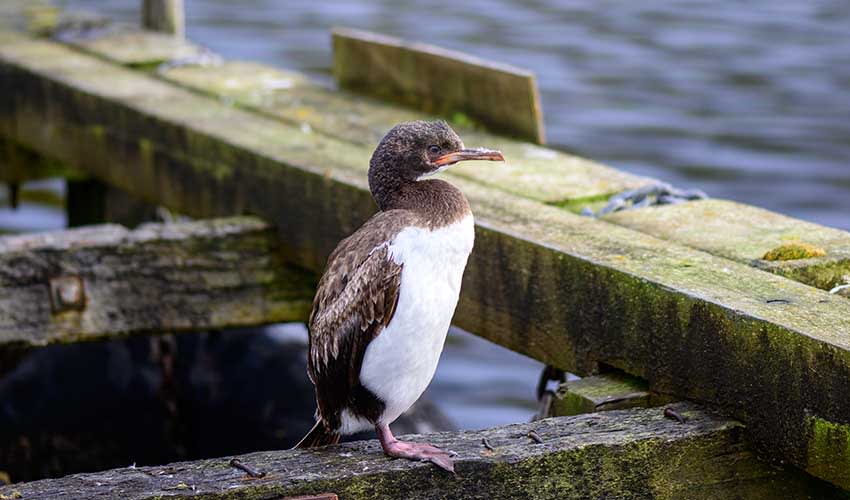
Living in one of the most isolated and windswept places on Earth, this shag has adapted to a harsh environment of cold seas, frequent storms, and rugged coastlines. Medium-sized and sturdy, it has a thick neck, strong bill, and solid body that reflect its powerful diving lifestyle. Its plumage is striking, with dark upperparts contrasted by white markings on the face and neck, giving it a bold and easily recognizable appearance when perched on coastal rocks.
A defining feature of the Campbell Island shag is its close dependence on the surrounding ocean. It is an expert diver, foraging in nearshore waters where fish are abundant. Using its webbed feet, it propels itself underwater with steady, forceful strokes, maneuvering skillfully through cold and often turbulent seas. Unlike birds that rely on speed alone, this shag uses strength and control to chase prey along the seabed. After feeding, it frequently returns to rocky ledges to rest and dry its feathers.
Like all shags and cormorants, the Campbell Island shag has feathers that are not fully waterproof. While this reduces buoyancy and improves diving efficiency, it means the bird must dry its wings after time in the water. As a result, it is often seen standing upright with wings spread wide, facing into the wind. This posture is a familiar sight along the island’s rocky shores and is among the most iconic behaviors of shags.
What sets the Campbell Island shag apart from many other shag species is its extreme isolation. Its entire population is confined to a single island, making it especially vulnerable to environmental changes. Severe storms, shifts in fish populations, and habitat disturbance can have a major impact on a species with such a limited range. At the same time, this isolation has protected it from many human pressures, such as coastal development and introduced predators, that affect seabirds elsewhere.
Distribution
 New Zealand
 Official estimate
Anything we've missed?
Help us improve this page by suggesting edits. Glory never dies!
Suggest an editGet to know me
Terrestrial / Aquatic
Altricial / Precocial
Polygamous / Monogamous
Dimorphic (size) / Monomorphic
Active: Diurnal / Nocturnal
Social behavior: Solitary / Pack / Flock
Diet: Carnivore / Herbivore / Omnivore / Piscivorous / Insectivore
Migratory: Yes / No
Domesticated: Yes / No
Dangerous: Yes / No




