


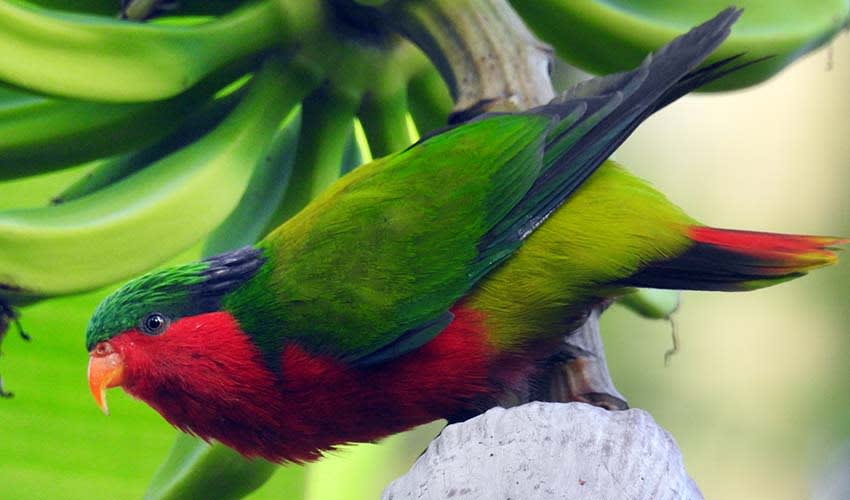
Compact and energetic, this lorikeet is immediately recognizable by its vivid plumage and lively behavior. Its body is mostly bright green, which helps it blend into tropical forests, but its head and chest display striking splashes of red, blue, and yellow. The face often wears a bold red mask, while blue tones appear on the crown and around the eyes, creating a dramatic, expressive look. Like other lorikeets, it has a short tail, a curved beak, and an alert posture that reflects its constant activity.
One of the most distinctive characteristics of Kuhl’s lorikeet is its specialized feeding adaptation. Instead of a smooth tongue like seed-eating parrots, it has a brush-tipped tongue designed for feeding on nectar and pollen. This allows it to feed efficiently on flowering trees, which form the core of its diet. It also eats soft fruits and blossoms, making it closely tied to healthy island forests. This feeding style sets it apart from many other parrots and makes it an important pollinator, as it carries pollen from flower to flower while feeding.
Kuhl’s lorikeet is highly social and active. It is usually seen in pairs or small flocks moving quickly through the treetops. These birds are rarely still; they constantly fly, climb, and call to one another. Their calls are sharp and high-pitched, often heard before the birds are seen. Despite their small size, they have bold personalities and are not easily intimidated. Strong social bonds are common, especially between mates, which often remain close throughout the day while feeding and resting.
What distinguishes Kuhl’s lorikeet from many other lorikeets is its island-based lifestyle. It lives in a relatively small geographic area, which has allowed it to develop strong connections to local plant species and seasonal flowering patterns. While some lorikeets are widespread across large regions, Kuhl’s lorikeet depends on the stability of island ecosystems.
Distribution
 Cook Islands
 French Polynesia
 Kiribati
Anything we've missed?
Help us improve this page by suggesting edits. Glory never dies!
Suggest an editGet to know me
Terrestrial / Aquatic
Altricial / Precocial
Polygamous / Monogamous
Dimorphic (size) / Monomorphic
Active: Diurnal / Nocturnal
Social behavior: Solitary / Pack / Flock
Diet: Carnivore / Herbivore / Omnivore / Piscivorous / Insectivore
Migratory: Yes / No
Domesticated: Yes / No
Dangerous: Yes / No




