


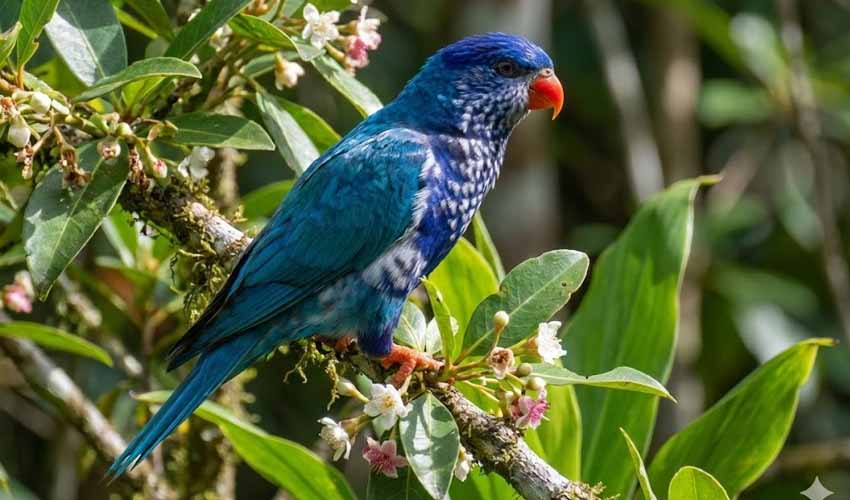
A small and brilliantly colored parrot that once lived only on a few remote islands in the Pacific. It is one of the most visually striking lorikeets ever recorded. Its name comes from its deep blue, almost violet coloring, which covered much of its head and upper body. This rich blue was often contrasted with darker shades on the wings and lighter tones on the underside, giving the bird a bold yet balanced appearance. Like other lorikeets, it had a compact body, a short tail, and an alert, energetic posture that reflected its active lifestyle among flowering trees.
One of the most distinctive features of the ultramarine lorikeet was its intense coloration. While many lorikeets are known for bright mixes of red, green, and yellow, this species stood out for its dominant blue tones. The color was so vivid that early observers described it as glowing in sunlight. This made the bird visually unique even within the colorful lorikeet group. Its curved beak and bright eyes added to its expressive look, making it one of the most memorable parrots of its region despite its small size.
Like all lorikeets, the ultramarine lorikeet was specially adapted for a nectar-based diet. It had a brush-tipped tongue that allowed it to feed on nectar and pollen from flowers, as well as soft fruits. This feeding style tied it closely to healthy forests with abundant flowering plants. As it moved from tree to tree, it likely played an important role in pollination, helping plants reproduce. Unlike seed-eating parrots, which can sometimes adapt to different environments, nectar feeders depend heavily on stable plant communities, making the ultramarine lorikeet especially sensitive to environmental change.
Distribution
 French Polynesia
 Official estimate
Anything we've missed?
Help us improve this page by suggesting edits. Glory never dies!
Suggest an editGet to know me
Terrestrial / Aquatic
Altricial / Precocial
Polygamous / Monogamous
Dimorphic (size) / Monomorphic
Active: Diurnal / Nocturnal
Social behavior: Solitary / Pack / Flock
Diet: Carnivore / Herbivore / Omnivore / Piscivorous / Insectivore
Migratory: Yes / No
Domesticated: Yes / No
Dangerous: Yes / No




