


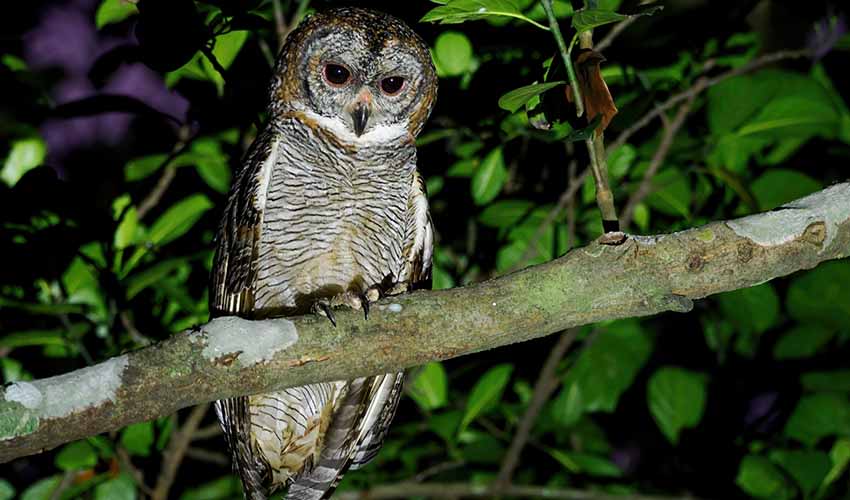
A striking and powerful bird found in forests, plantations, and even large gardens across South and Southeast Asia. It is known for its broad wings, large rounded head, and bold presence, which make it one of the most impressive owls in its range. Its name comes from the mottled pattern on its feathers, a mix of brown, cream, and gray that helps it blend into tree trunks and shaded branches. Unlike smaller owls that rely on secrecy, the mottled wood owl often appears confident and alert, perched upright during the day and watching its surroundings with steady, dark eyes.
One of the most noticeable features of the mottled wood owl is its size and posture. It is larger and heavier than many other forest owls, giving it a commanding appearance. Its feathers are dense and layered, providing insulation and allowing for smooth, silent flight. The facial disc, the rounded area around its eyes, is less sharply defined than in some other owls, giving its face a softer look. However, this gentle appearance contrasts with its deep, booming call, which can carry far through the forest at night. This call is one of the easiest ways to recognize the species and is often heard long before the owl itself is seen.
What distinguishes the mottled wood owl from other wood owls is its adaptability and tolerance of human presence. While many owls avoid areas near people, this species is often found close to villages, farms, and wooded parks, as long as there are tall trees for roosting. It is mostly active at night, but it can sometimes be seen at dusk or even resting openly during the day. Its diet is varied, including rodents, birds, reptiles, and large insects, making it an important predator that helps keep local ecosystems balanced. Compared to related owls, it is less secretive and more likely to return to the same roosting spot day after day.
Distribution
 India
India Myanmar
 Pakistan
Anything we've missed?
Help us improve this page by suggesting edits. Glory never dies!
Suggest an editGet to know me
Terrestrial / Aquatic
Altricial / Precocial
Polygamous / Monogamous
Dimorphic (size) / Monomorphic
Active: Diurnal / Nocturnal
Social behavior: Solitary / Pack / Herd
Diet: Carnivore / Herbivore / Omnivore / Piscivorous / Insectivore
Migratory: Yes / No
Domesticated: Yes / No
Dangerous: Yes / No




