


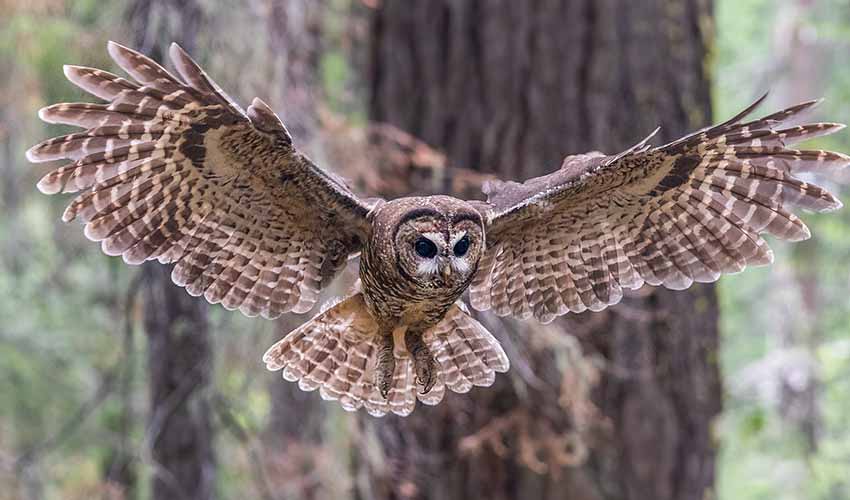
A well-known forest owl that lives in parts of North America, especially in old, dense forests with tall trees and a cool, shaded atmosphere. It is medium-sized, with a rounded head, dark eyes, and no ear tufts, giving it a calm and gentle appearance. Its name comes from the white spots scattered across its dark brown feathers, which create a beautiful pattern and help it blend into the dappled light of the forest. Unlike many owls that prefer open spaces, the spotted owl depends strongly on thick forests, where it can roost quietly during the day and hunt at night.
One of the most distinctive features of the spotted owl is its strong connection to mature forests. Compared to other owls, it relies heavily on large, old trees for nesting and shelter. These trees often have natural cavities or broken tops that provide safe nesting spots. The spotted owl is not a fast or aggressive hunter like some larger owls; instead, it uses patience and precision. It often sits silently on a branch, listening carefully before gliding down to catch small mammals. Its flight is smooth and nearly silent, allowing it to move through the forest without drawing attention.
What truly sets the spotted owl apart from other similar owls is its behavior and personality. It is known for being relatively calm and curious, sometimes watching humans quietly rather than immediately flying away. This has made it easier to study than many other shy owl species. Its call is soft and rhythmic, often described as a series of gentle hoots rather than a sharp or loud cry. Unlike some owls that travel long distances, the spotted owl usually stays within the same territory throughout its life, forming strong bonds with its surroundings and with its mate.
Distribution
 Canada
 Mexico
 United States
Anything we've missed?
Help us improve this page by suggesting edits. Glory never dies!
Suggest an editGet to know me
Terrestrial / Aquatic
Altricial / Precocial
Polygamous / Monogamous
Dimorphic (size) / Monomorphic
Active: Diurnal / Nocturnal
Social behavior: Solitary / Pack / Herd
Diet: Carnivore / Herbivore / Omnivore / Piscivorous / Insectivore
Migratory: Yes / No
Domesticated: Yes / No
Dangerous: Yes / No




