


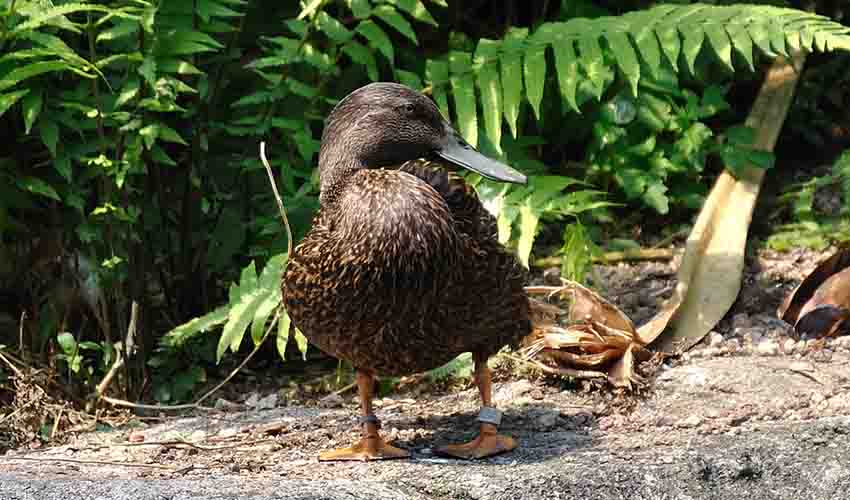
A large, sturdy duck found only in Madagascar, and it looks like it was designed with quiet confidence rather than bright showmanship. Its feathers are mostly deep brown with a fine, scaly pattern, and a glossy green or bluish patch on the wing flashes when it flies. It doesn’t have the bold head markings many people expect in ducks, and that plainness is actually part of its charm—Meller’s duck blends into shadowy wetlands and forested rivers like a living piece of driftwood. Males and females look very similar, so it’s not a “dressy male” species; instead, both sexes share the same practical outfit suited for a life spent around water and thick vegetation.
What makes Meller’s duck stand out is its preference for Madagascar’s quieter freshwater places—lakes, marshes, slow rivers, and wooded streams—especially where there’s plenty of cover and a healthy mix of shallow water and plants. It often feeds by dabbling and tipping forward in the water, but it can also graze along the edges, nibbling plant material like a small waterfowl version of a lawn mower. Its diet is flexible, including seeds, water plants, and small water creatures, which helps it cope with seasonal changes. When disturbed, Meller’s duck tends to choose a cautious escape: it may freeze and hide first, trusting its camouflage, and only fly when it truly has to.
In personality, this duck is often described as wary and private. It isn’t the type to parade around busy open ponds, and it can be surprisingly hard to approach, even though it’s a big bird. Pairs may keep close together, and outside the breeding season, you might see small groups, but it doesn’t typically form massive flocks like some more common ducks. Its voice is also more understated than you might expect: instead of constant loud quacking, it can be relatively quiet, using soft calls and low notes that suit a bird trying not to advertise itself in a landscape full of potential threats.
Distribution
 Madagascar
 Mauritius
Anything we've missed?
Help us improve this page by suggesting edits. Glory never dies!
Suggest an editGet to know me
Terrestrial / Aquatic
Altricial / Precocial
Polygamous / Monogamous
Dimorphic (size) / Monomorphic
Active: Diurnal / Nocturnal
Social behavior: Solitary / Pack / Flock
Diet: Carnivore / Herbivore / Omnivore / Piscivorous / Insectivore
Migratory: Yes / No
Domesticated: Yes / No
Dangerous: Yes / No




