


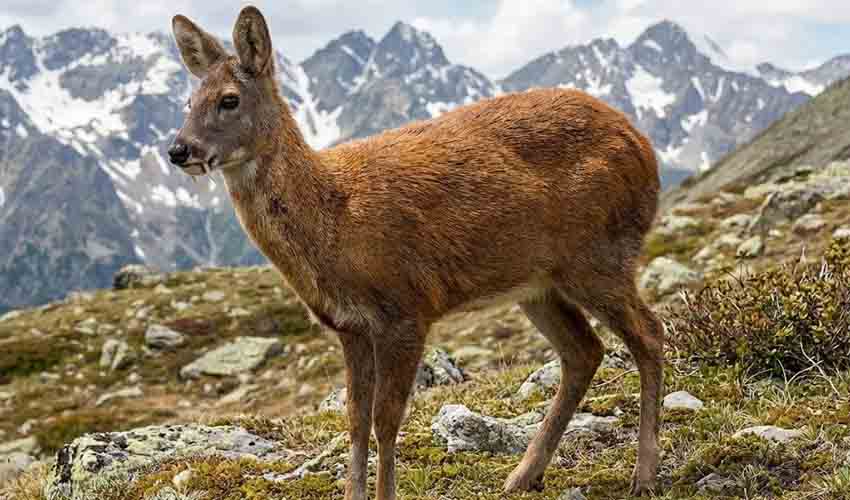
A small, secretive mountain animal that looks deer-like at first glance, but it breaks the usual deer rules in memorable ways. It has no antlers at all, a compact body, long legs built for steep ground, and a thick coat that helps it handle cold air and sudden weather. Its fur is often grizzled brown to gray-brown, blending perfectly with rocky slopes, dry grass, and shadowy forest edges. The face is narrow and alert, with large ears that swivel constantly as if it’s always “listening ahead.” If you ever saw one clearly, the most surprising detail—especially on a male—is the set of long upper canine teeth that can stick out like small fangs. They aren’t for hunting; they’re more like built-in rivalry tools, giving this shy plant-eater a slightly wild, almost mythical look.
While some musk deer are more closely associated with darker, dense forests, the alpine musk deer is often linked to higher, harsher landscapes—alpine scrub, steep slopes, and forest edges where the ground is uneven and the air can feel thin. That habitat shapes its whole lifestyle. It doesn’t rely on open running like a typical deer in a meadow; it relies on climbing skill, careful footing, and a habit of staying close to cover. Its coat also fits this “above-the-treeline or near-treeline” world: thicker and more insulating, with colors that match rock, soil, and winter-dulled plants.
The alpine musk deer is also different from true deer in how it communicates and defends space. Instead of antlers and dramatic displays, musk deer live in a world of scent. Males have a special scent gland that produces musk, used mainly as a powerful signal during the breeding season. In a landscape where wind and terrain can hide animals from view, scent messages can outlast a call and travel farther than a quick glimpse. Alpine musk deer also tend to be solitary and territorial, often using repeated “latrine” spots—regular droppings sites—to leave information for neighbors, like a bulletin board that says “occupied.”
Distribution
 Bhutan
 China
China India
India Nepal
NepalAnything we've missed?
Help us improve this page by suggesting edits. Glory never dies!
Suggest an editGet to know me
Terrestrial / Aquatic
Altricial / Precocial
Polygamous / Monogamous
Dimorphic (size) / Monomorphic
Active: Diurnal / Nocturnal
Social behavior: Solitary / Pack / Herd
Diet: Carnivore / Herbivore / Omnivore / Piscivorous / Insectivore
Migratory: Yes / No
Domesticated: Yes / No
Dangerous: Yes / No




