


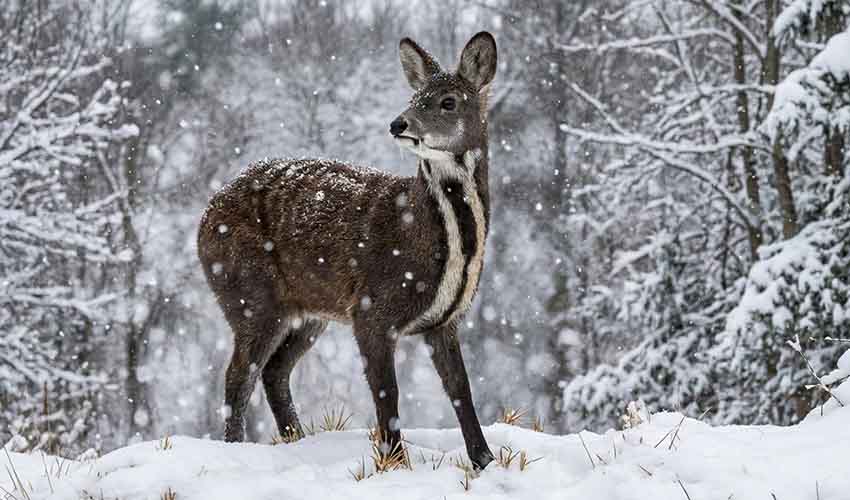
This deer lives only in and around the Dabie Mountains on the border of Anhui Province, and probably nearby parts of Hubei, which means it’s found nowhere else on Earth. Picture a small, antlerless deer with big dark eyes, rabbit-like ears, and a grey-brown coat that blends perfectly with rocks, fallen leaves, and winter undergrowth. Instead of antlers, the males have long upper canine teeth that grow into small tusks, which can stick out of the mouth like a fantasy creature’s fangs. These tusks are used mostly for display and for tussling with rival males, but despite the “vampire” look, Anhui musk deer are plant-eaters, nibbling leaves, grasses, twigs, and lichens on steep, forested slopes.
What really sets this species apart is its musk and its extreme rarity. Like other musk deer, males have a special scent gland on their belly that produces a strong, earthy perfume called musk. For centuries, this musk has been highly prized for perfumes and traditional medicine, and a single musk pod can sell for a huge amount of money. Because it is easier and cheaper for poachers to shoot the deer than to keep them alive and farm the musk, hunting has hammered the population. Old estimates suggested only a few hundred to maybe around a thousand animals, and the species is now considered endangered, with some Chinese assessments treating it as critically endangered.
On top of that, the forests it needs are being broken up by roads, farms, and development, so its world is shrinking into scattered patches of high, dense woodland. Recent habitat studies suggest that its suitable mountain habitat is already limited and may shrink further as the climate warms, pushing the deer to even higher elevations.
Distribution
 China
China Official estimate
Anything we've missed?
Help us improve this page by suggesting edits. Glory never dies!
Suggest an editGet to know me
Terrestrial / Aquatic
Altricial / Precocial
Polygamous / Monogamous
Dimorphic (size) / Monomorphic
Active: Diurnal / Nocturnal
Social behavior: Solitary / Pack / Herd
Diet: Carnivore / Herbivore / Omnivore / Piscivorous / Insectivore
Migratory: Yes / No
Domesticated: Yes / No
Dangerous: Yes / No




