


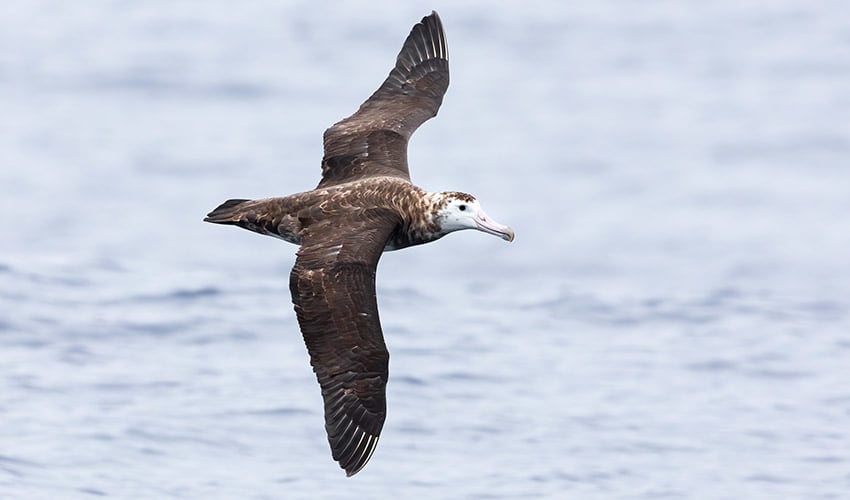
One of the rarest seabirds in the world and one of the most mysterious. It lives almost its entire life over the open ocean, gliding effortlessly above waves for hours without flapping its wings. This large bird has long, narrow wings designed for soaring, a pale body, and darker wings that give it a striking, elegant look in flight. What makes it especially remarkable is how little land it needs: the Amsterdam albatross comes ashore only to breed, and even then it uses just one tiny place on Earth—Amsterdam Island, a remote speck in the southern Indian Ocean.
Most albatrosses nest on several islands and roam huge stretches of ocean shared with other populations. The Amsterdam albatross, however, breeds on a single island and in a very small area on that island. For a long time, it was even mistaken for a type of wandering albatross, until scientists realized it was its own distinct species. Compared to its close relatives, it is slightly smaller and darker, with differences in plumage and body shape that reflect its unique history. Being so restricted has made it one of the most vulnerable seabirds on the planet, but also one of the most unique.
The lifestyle of the Amsterdam albatross is a blend of patience and endurance. It feeds mainly on squid and fish, snatching food from the ocean’s surface or just below it. Using strong winds, it can travel thousands of kilometers across the sea with very little effort, a technique that makes albatrosses some of the most energy-efficient flyers in the animal world. When it is time to breed, the bird returns faithfully to Amsterdam Island, often to the same nesting area year after year.
Distribution
 French Southern T.
Anything we've missed?
Help us improve this page by suggesting edits. Glory never dies!
Suggest an editGet to know me
Terrestrial / Aquatic
Altricial / Precocial
Polygamous / Monogamous
Dimorphic (size) / Monomorphic
Active: Diurnal / Nocturnal
Social behavior: Solitary / Pack / Herd
Diet: Carnivore / Herbivore / Omnivore / Piscivorous / Insectivore
Migratory: Yes / No
Domesticated: Yes / No
Dangerous: Yes / No




