


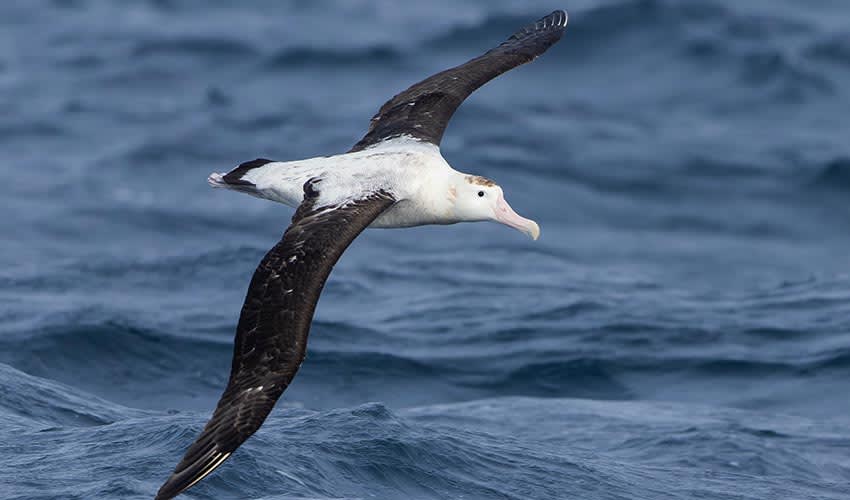
One of the largest and most impressive seabirds in the world, known for its incredible size, endurance, and ocean-going lifestyle. Native to the remote Antipodes Islands south of New Zealand, this bird spends most of its life far from land, soaring over vast stretches of the Southern Ocean. With an enormous wingspan that can reach over three meters, the Antipodean albatross is built for long-distance flight. Its wings are long and narrow, allowing it to glide effortlessly on ocean winds for hours without flapping. This graceful flying style helps it travel thousands of kilometers while using very little energy. Its body is mostly white, with darker wings and markings that give it a bold, striking look against the open sea.
These birds usually form long-lasting pairs, often staying with the same mate for life. Their courtship involves a series of elaborate dances, calls, and bill movements that help strengthen their bond. They return to the same nesting area year after year, even after spending months roaming the ocean. Compared to other albatrosses, the Antipodean albatross has a particularly long breeding cycle. From laying an egg to raising a chick, the process can take almost an entire year, requiring great patience and teamwork from both parents.
Life at sea has shaped many of the Antipodean albatross’s unique traits. These birds are excellent navigators and can travel across entire ocean basins in search of food. They mainly feed on squid and fish, often scooping prey from the surface of the water. Their keen sense of smell helps them locate food over huge distances, which is unusual for birds. They can spend years at sea without touching land, only returning to breed. This ocean-focused lifestyle makes them masters of endurance and survival, able to withstand rough weather, strong winds, and massive waves.
Distribution
 Antarctica
 Australia
 Chile
Chile French Polynesia
 New Zealand
 Norfolk Island
Anything we've missed?
Help us improve this page by suggesting edits. Glory never dies!
Suggest an editGet to know me
Terrestrial / Aquatic
Altricial / Precocial
Polygamous / Monogamous
Dimorphic (size) / Monomorphic
Active: Diurnal / Nocturnal
Social behavior: Solitary / Pack / Flock
Diet: Carnivore / Herbivore / Omnivore / Piscivorous / Insectivore
Migratory: Yes / No
Domesticated: Yes / No
Dangerous: Yes / No




