


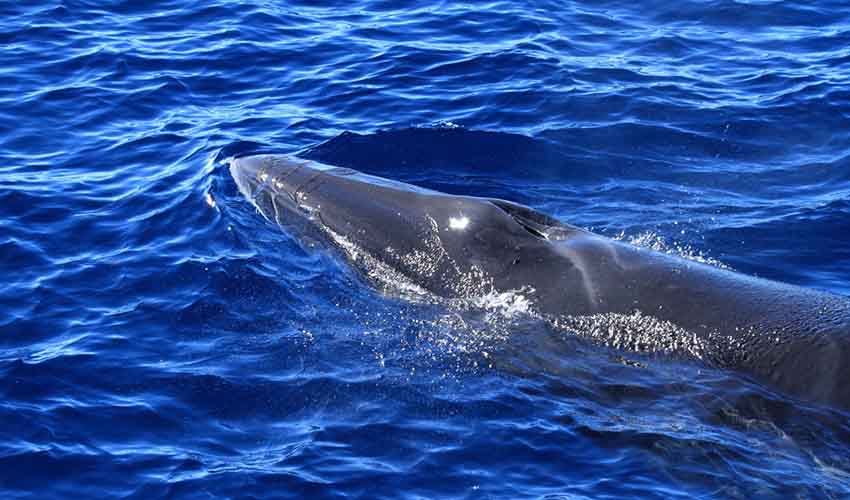
The sleek, ice-dwelling cousin of the more familiar common minke whale, built for life in the frigid waters of the Southern Ocean. It has a streamlined torpedo shape, pointed head, and smooth slate-gray body that fades to lighter tones on the belly. Unlike its northern relative, it lacks the bright white flipper patches, giving it a more understated, shadow-in-the-snow aesthetic. Its size and hydrodynamic design allow it to move quickly and gracefully, weaving among sea ice with surprising agility.
Antarctic minke whales spend much of their year in icy, plankton-rich Antarctic waters, following the seasonal pulse of life tied to krill — their main food source. They use baleen plates to filter huge volumes of water, trapping tiny shrimp-like krill in dense swarms beneath the ice edge. During feeding peaks, they perform lunge-feeding dives, accelerating toward prey balls and engulfing vast amounts of water and krill in one sweep. Their throat grooves expand like elastic accordions to hold it all, then contract as water is pushed out and food is swallowed. In winter, many migrate northward into sub-Antarctic or temperate waters, though their movements remain less understood than those of larger whales.
Life under the ice requires a special toolkit. These whales often spyhop among ice floes, poking their heads out to find breathing holes or navigate shifting ice fields. Their excellent maneuverability helps them dart through tight channels, and they can hold their breath for over 20 minutes when necessary. Generally solitary or traveling in small groups, they communicate in soft, low-frequency sounds and behave calmly around other whales — though they can burst into surprising speed when startled or hunting.
While the species remains relatively abundant compared to many other baleen whales, it still faces modern pressures: climate change, shifting sea-ice patterns, and competition or disruption linked to changing krill dynamics. Sea ice isn’t just scenery — it’s feeding ground, nursery space for krill, and part of the species’ seasonal rhythm. Any change reverberates through the ecosystem.
Distribution
 Atlantic Ocean
 Indian ocean
 Pacific ocean
 Angola
 Antarctica
 Argentina
 Australia
 Brazil
 Chile
Chile Comoros
 Fiji
Fiji French Guiana
 French Polynesia
 French Southern T.
 Indonesia
 Kenya
Kenya Madagascar
 Mauritius
 Mayotte
 Mozambique
 Namibia
 New Caledonia
 New Zealand
 Peru
Réunion
Peru
Réunion South Africa
 South Georgia
 Suriname
 Tanzania
 Uruguay
 Vanuatu
Anything we've missed?
Help us improve this page by suggesting edits. Glory never dies!
Suggest an editGet to know me
Terrestrial / Aquatic
Altricial / Precocial
Polygamous / Monogamous
Dimorphic (size) / Monomorphic
Active: Diurnal / Nocturnal
Social behavior: Solitary / Pack / Herd
Diet: Carnivore / Herbivore / Omnivore / Piscivorous / Insectivore
Migratory: Yes / No
Domesticated: Yes / No
Dangerous: Yes / No




