


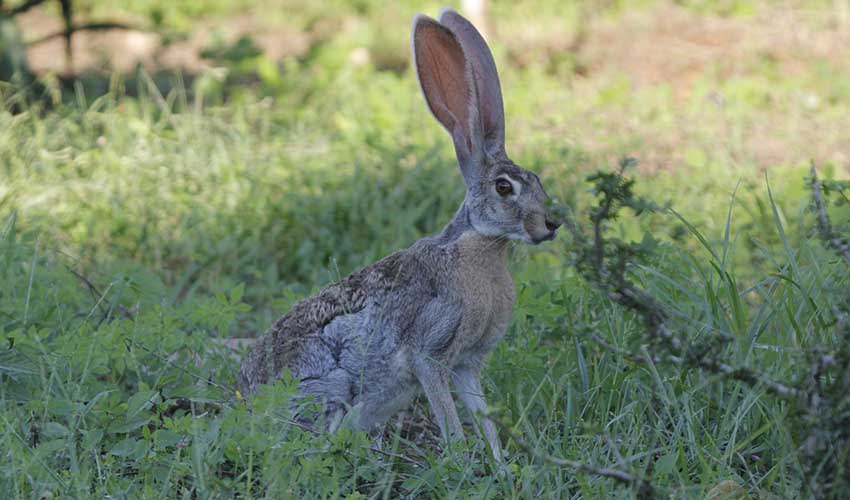
A long-legged sprinter of the American Southwest and northern Mexico, built for open spaces where speed is the best defense. It’s one of the largest jackrabbits, with an athletic, lean body, long hind legs like springs, and famously huge ears that look almost oversized until you realize they’re part of its survival kit. Its coat is usually tan to gray-brown on top with a paler underside, helping it blend into dry grasslands, desert scrub, and sandy soils. The face is narrow, the eyes sit high for wide-angle awareness, and the tail is often pale underneath—so when it runs, you may see quick flashes of white.
Many jackrabbits are fast, but this one is especially associated with wide, grassy deserts and plains where there are fewer places to hide. Instead of relying mainly on thick brush, it depends on early detection and a powerful getaway. Its legs are proportionally long, and its body posture often appears taller and more upright than that of some relatives when it sits alert. The ears, besides being great sound catchers, help it cool down by releasing heat—handy in hot environments where overheating can be as dangerous as predators. Compared with smaller rabbits that duck into burrows, jackrabbits usually don’t dig their own burrows; they use shallow depressions called “forms,” which are basically natural hideouts scraped into the ground.
Daily life for an antelope jackrabbit is a careful routine of eating, listening, and staying ready to launch. It feeds mostly on grasses and other plants, often switching between green growth when it’s available and tougher, drier plants when conditions are harsh. It can be most active during cooler parts of the day—dawn, dusk, and nighttime—when temperatures drop, and predators are easier to spot against the fading light.
Distribution
 Mexico
 United States
Anything we've missed?
Help us improve this page by suggesting edits. Glory never dies!
Suggest an editGet to know me
Terrestrial / Aquatic
Altricial / Precocial
Polygamous / Monogamous
Dimorphic (size) / Monomorphic
Active: Diurnal / Nocturnal
Social behavior: Solitary / Pack / Herd
Diet: Carnivore / Folivore / Graminivore / Piscivorous / Insectivore
Migratory: Yes / No
Domesticated: Yes / No
Dangerous: Yes / No




