


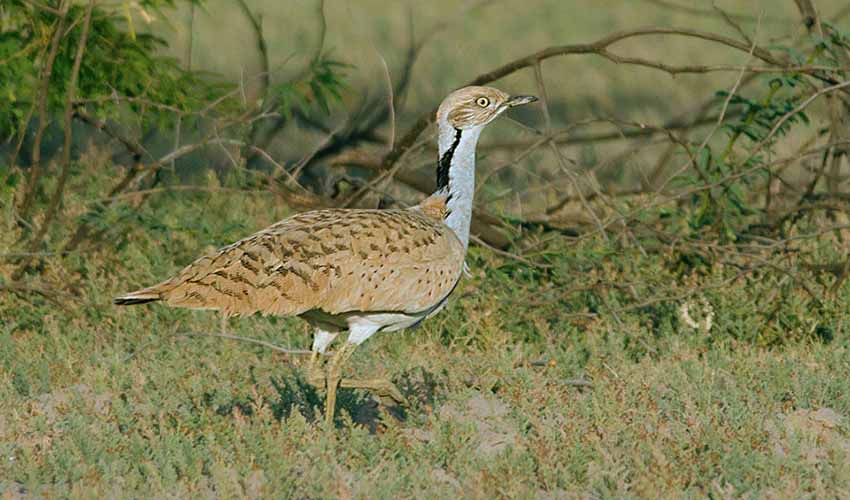
A desert bird built for wide horizons, heat, and the kind of quiet that comes with open land. It lives across parts of Central Asia and the Middle East, favoring dry plains, semi-deserts, and scrubby areas where bushes are low, and the ground stretches out in muted browns and tans. Its own colors match this world perfectly. From a distance, the Asian houbara can look like a moving patch of sand and dry grass, with soft patterns that break up its outline. This camouflage is not just a nice feature—it is a survival tool, because in open country there are few places to hide, and being hard to notice can be the difference between living and being chased.
Most of the time, the Asian houbara behaves like a careful walker. It spends hours on foot, stepping steadily and often pausing to look around. It can fly, but it usually chooses not to unless it must. If it senses trouble, it may first try to slip away quietly, keeping low and moving fast through sparse cover. When it finally takes off, it often starts with a run, then launches with strong wingbeats. Once airborne, it can travel farther than many people expect, and some populations make long seasonal movements to reach better feeding or breeding areas. Still, even with that ability, the bird’s lifestyle is mostly grounded—its world is measured in footsteps more than in flight miles.
Food in dry regions is unpredictable, so the Asian houbara survives by being flexible. It eats insects, seeds, shoots, and other plant parts, and may also take small animals when the opportunity arises. After rain, deserts can suddenly produce swarms of insects and fresh plant growth, and the houbara takes advantage quickly, feeding heavily while the opportunity lasts. During harsher periods, it shifts to tougher plant foods and whatever seeds it can find. It also gains much of its moisture from what it eats, which helps it cope in areas where water sources are scattered or seasonal.
Distribution
 Afghanistan
 Bahrain
 China
China Egypt
Egypt India
India Iran
Iran Iraq
Iraq Israel
 Jordan
 Kazakhstan
 Kuwait
 Kyrgyzstan
 Mongolia
 Oman
Oman Pakistan
 Qatar
Qatar Saudi Arabia
 Syria
Syria Tajikistan
 Turkmenistan
 Turkey
 Official estimate
 UAE
UAE Uzbekistan
 Yemen
YemenAnything we've missed?
Help us improve this page by suggesting edits. Glory never dies!
Suggest an editGet to know me
Terrestrial / Aquatic
Altricial / Precocial
Polygamous / Monogamous
Dimorphic (size) / Monomorphic
Active: Diurnal / Nocturnal
Social behavior: Solitary / Pack / Herd
Diet: Carnivore / Herbivore / Omnivore / Piscivorous / Insectivore
Migratory: Yes / No
Domesticated: Yes / No
Dangerous: Yes / No




