


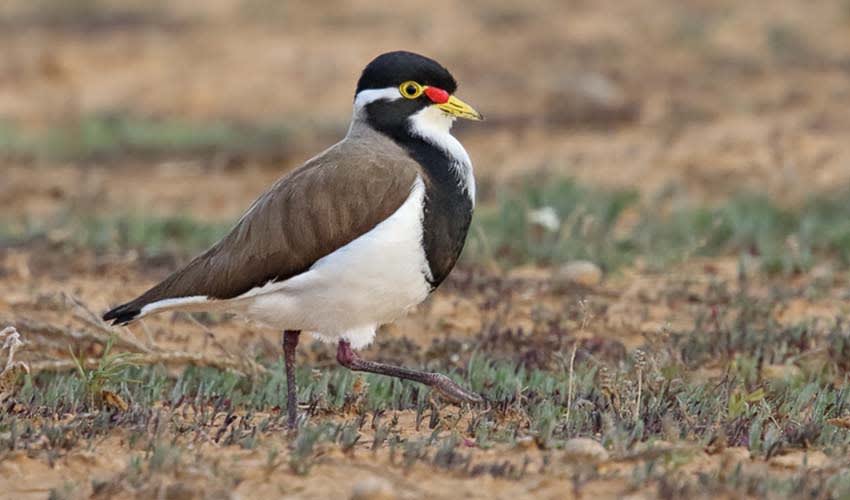
A striking bird native to the open grasslands and agricultural plains of Australia. Its upperparts are mostly a muted grey-brown, while the underparts remain clean white. What catches the eye is the sharp contrast created by its black cap, the wide black band stretching across its breast and up around the neck, and a white throat and eyebrow line. The bird also sports a pale yellow bill tipped with black and bright yellow eyes. This bold yet understated palette makes it stand out in the low grass or open paddocks where it lives.
Unlike many shorebirds that depend on water, the banded lapwing has carved out a life in dry, open country—often far from wetlands. It thrives in heavily grazed fields, cereal crops, short grassy plains and even saline herblands, especially where the vegetation is short and visibility is high. Such wide open spaces suit its lifestyle: it walks slowly and deliberately across the ground as it forages, only breaking into a faster trot or quick flight when disturbed. Its diet is composed mainly of insects, ants, termites, beetles, worms and other small invertebrates found in the short grass or bare ground.
Breeding for the banded lapwing is a display of adaptation to its open-terrain world. The bird nests directly on the ground, choosing a shallow scrape in bare or sparsely vegetated soil, usually in full view across the flat landscape so the sitting bird can watch for predators. When predators or threats approach, the adult lapwings become fiercely protective—performing distraction displays, loud alarm calls (“kew-kew-kew” or a descending “er-chill-char” sound), and even diving or swooping at intruders to lure them away from the nest. This fearless defence belies their modest size, but in their open world, visibility is protection and vigilance is key.
Distribution
 Australia
Anything we've missed?
Help us improve this page by suggesting edits. Glory never dies!
Suggest an editGet to know me
Terrestrial / Aquatic
Altricial / Precocial
Polygamous / Monogamous
Dimorphic (size) / Monomorphic
Active: Diurnal / Nocturnal
Social behavior: Solitary / Pack / Flock
Diet: Carnivore / Herbivore / Omnivore / Piscivorous / Insectivore
Migratory: Yes / No
Domesticated: Yes / No
Dangerous: Yes / No




